Learn how Order Blocks reveal institutional activity and high-probability reaction zones.

Order Blocks
- Define the selected candle and impulse
- Do not infer institutional intent
- Measure reactions and failed setups
- Test complete rules after costs
Order blocks are discretionary chart zones, commonly defined around the last opposite-direction candle before a specified price move. Candles do not identify institutional orders. Price often revisits these zones before continuing the move.
Traders may watch these zones for reactions, but institutional activity or reloading cannot be established from price candles alone.
What Is An Order Block
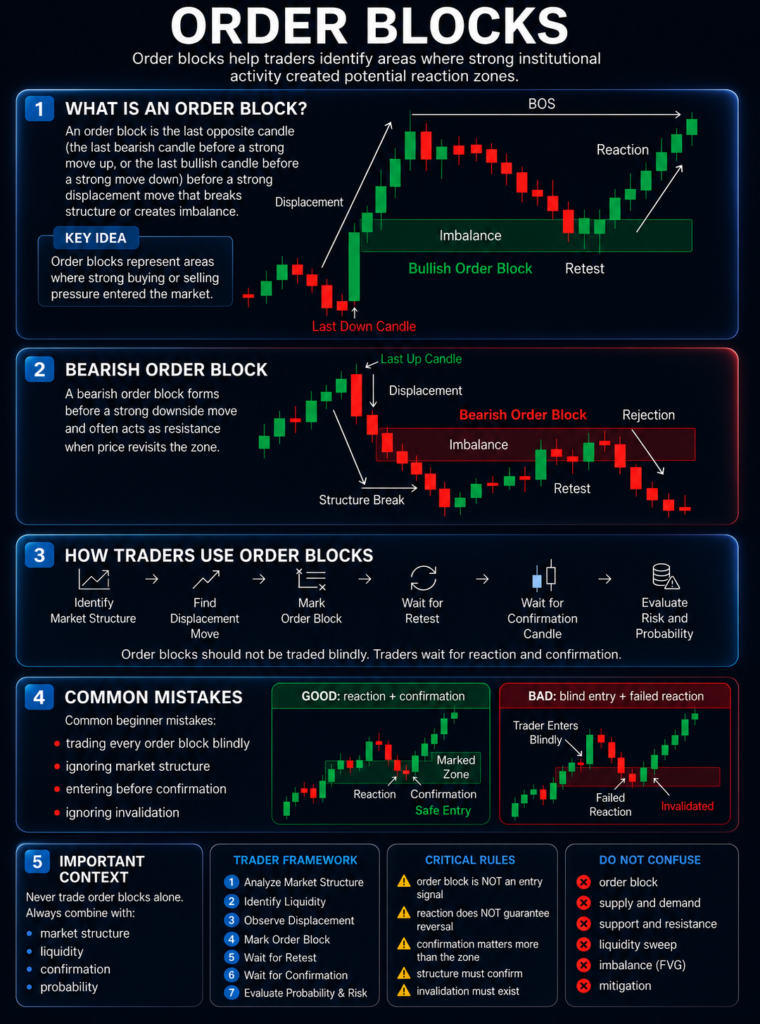
An Order Block is usually the last opposite candle before an impulsive move.
- Bullish Order Block = last down candle before a strong upward move
- Bearish Order Block = last up candle before a strong downward move
- Strong displacement often follows
- Price frequently revisits the zone later
Valid Order Blocks often appear near liquidity and structure shifts.
How To Identify An Order Block
Common selection rules use displacement and structure, but do not prove institutional participation.
- Strong impulsive move away from the zone
- Displacement with momentum
- Break of Structure (BOS) afterward
- Imbalance or Fair Value Gap nearby
Price returning to the zone creates potential reaction opportunities.
Order Block Framework
Strong Order Blocks usually follow a clear sequence.
Basic OB Logic:
Order Block = last opposite candle before an impulsive move.
Chart Zone Selection Framework:
Impulse + Displacement + BOS = a possible selection rule whose performance requires independent testing
- Impulse shows strong intent
- Displacement shows aggressive movement
- BOS confirms structure shifted
Additional conditions may reduce the number of signals and do not automatically improve their expected return.
How To Trade Order Blocks
- Wait for BOS or CHoCH confirmation
- Mark the Order Block zone
- Wait for retrace into the area
- Look for reaction or confirmation wick
- Combine with liquidity and imbalance
Order Blocks work best when structure, liquidity and confirmation align.
Quick Recap
- OB = discretionary chart reference zone
- Bullish OB = last down candle before expansion
- Bearish OB = last up candle before expansion
- BOS may be a filter; its effect on outcomes must be tested
- Confluence creates cleaner entries
Evidence and Risk Limits
These chart labels describe a chosen analytical framework, not verified institutional orders or guaranteed outcomes. Specify levels, timeframe, invalidation and execution costs before testing a rule. Compare results with independent data, including losing signals, and do not assume that adding confirmations increases expectancy.
End of lesson 7
Remember
- Order blocks are discretionary chart zones, not evidence of institutional orders.