Fair Value Gaps (FVG)
Learn how Fair Value Gaps reveal imbalance, momentum and precise retracement zones.

Fair Value Gaps (FVG)
- Wait for strong displacement
- Never trade FVG alone
- Confirm with structure and liquidity
- Use reactions, not assumptions
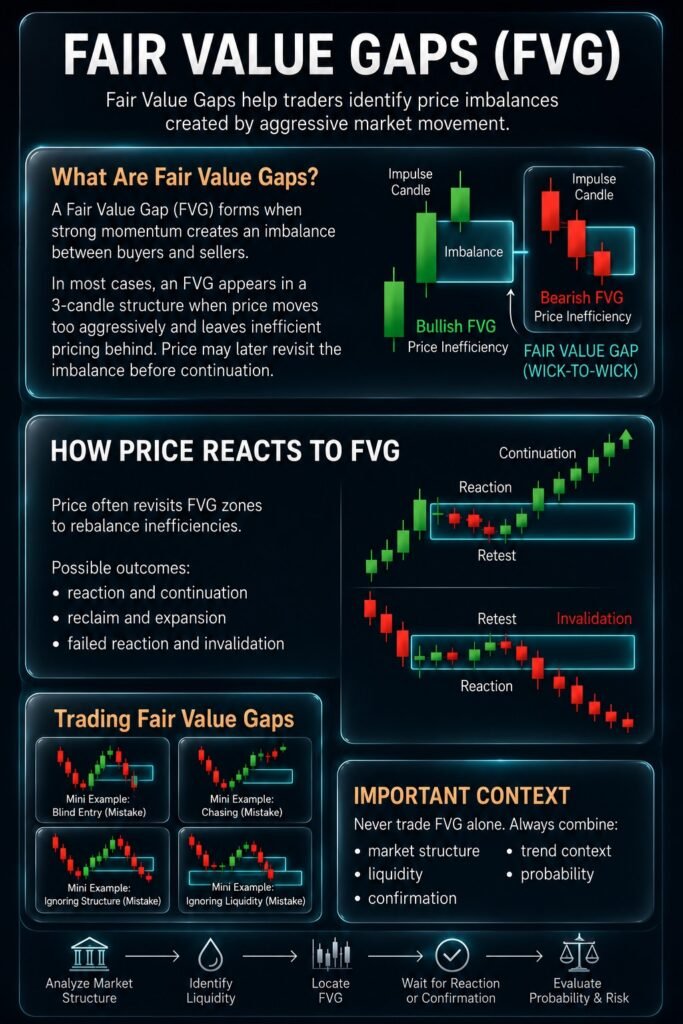
Fair Value Gaps (FVGs) are price imbalances left behind after aggressive movement. They form when price moves so fast that liquidity does not trade evenly.
FVGs often act as retracement zones where price returns before continuation.
What Is A Fair Value Gap
A Fair Value Gap forms inside a 3-candle structure.
- Candle 1 and Candle 3 do not overlap
- Candle 2 creates aggressive displacement
- The gap becomes an imbalance zone
- Price often revisits the area later
Bullish FVG forms below price after a strong upward move.
Bearish FVG forms above price after a strong downward move.
Imbalance often creates hidden support or resistance zones.
How To Read FVGs
Strong FVGs usually appear after momentum expansion.
- Large impulsive candles
- Clear displacement from liquidity
- Structure confirmation nearby
- Reaction after retesting the imbalance
Price often returns to rebalance inefficiency before continuing the trend.
How To Trade FVGs
- Wait for a strong move that creates imbalance
- Mark the gap zone
- Wait for price to revisit the area
- Look for confirmation from BOS or CHoCH
- Enter only after reaction appears
FVG works best when combined with structure, liquidity and confirmation.
Quick Recap
- FVG = imbalance created by momentum
- Price often revisits the gap
- Bigger gap = stronger imbalance
- Use FVG with structure and liquidity
- Imbalance creates opportunity. Confirmation creates entries.
FVG Gap Formula:
Bullish FVG
FVG Size = Candle 3 Low − Candle 1 High
Bearish FVG
FVG Size = Candle 1 Low − Candle 3 High
Example:
Candle 1 High = $95,000
Candle 3 Low = $96,200
FVG Size = 96,200 − 95,000
FVG Size = 1,200
How to read it:
- Bigger gap = stronger imbalance and stronger displacement
- Smaller gaps often rebalance faster
- Partial fill = price reacts inside the imbalance
- Full fill = price fully mitigates the imbalance
Beginner Pro-Tips:
- The Magnet: think of an FVG as a market magnet. Price often revisits inefficiency before continuation
- The 50% Rule: draw a line in the middle of the FVG. The midpoint is called Consequent Encroachment (CE) and often becomes the strongest reaction zone
- Invalidation Trap: if Candle 2 wicks already overlap Candle 1 or Candle 3, there is no valid imbalance
Advanced context:
Large FVGs can suggest strong institutional displacement where price moved too quickly for efficient trading.
Golden Rule:
Never trade an FVG blindly. Always wait for confirmation from structure, BOS or lower timeframe reaction.