Accumulation & Distribution
Learn how institutions quietly build and exit positions before major market moves.

Accumulation & Distribution
- Watch for sideways ranges
- Look for liquidity sweeps
- Wait for BOS confirmation
- Follow volume shifts
- Never assume range direction too early
Before major market moves, price often moves sideways. These quiet periods can reveal what larger players are doing behind the scenes.
Smart money rarely buys or sells aggressively all at once. Instead, positions are often built slowly through accumulation or distributed before a larger move.
What Is Accumulation
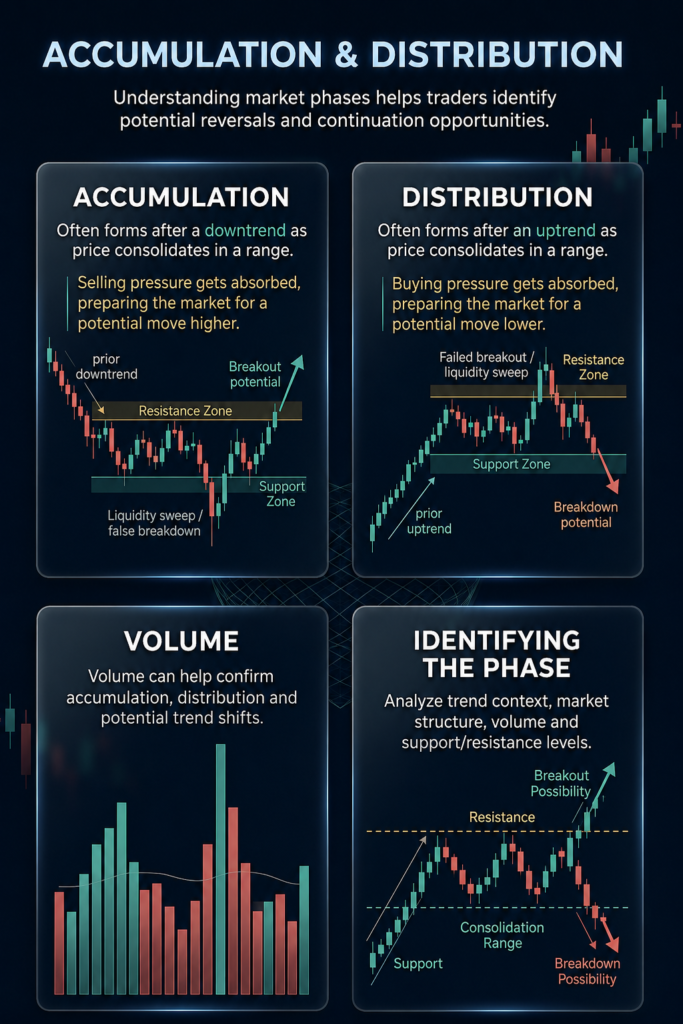
Accumulation usually forms after a downtrend when institutions quietly buy inside a range.
- Sideways range after weakness
- Liquidity sweeps below lows
- Higher lows begin to form
- Demand zones hold repeatedly
- Volume improves during recoveries
Accumulation often signals that selling pressure is fading and buyers are slowly taking control.
What Is Distribution
Distribution usually forms after an uptrend when larger players quietly sell into strength.
- Sideways range after expansion
- Liquidity sweeps above highs
- Lower highs begin to form
- Supply zones reject price
- Volume rises during sell pressure
Distribution often appears when late buyers enter and smart money begins exiting positions.
How To Confirm Direction
- Watch for liquidity sweeps on both sides of the range
- Wait for BOS to confirm direction
- Look for reclaim or rejection after the sweep
- Use volume to confirm participation
A range alone is not a signal. Confirmation matters.
How To Trade It
- Mark the full range clearly
- Wait for liquidity to be taken
- Trade after confirmation, not before
- Target liquidity pools or the opposite side of the range
Quick Recap
- Accumulation means stealth buying
- Distribution means stealth selling
- Liquidity sweeps often come first
- BOS confirms direction
- Volume helps reveal intent
- Sideways price action often hides the next major move.