Swing Failure Pattern (SFP)
Learn how Swing Failure Patterns reveal liquidity grabs and potential reversal opportunities.

← Back to Advanced Price Action
Swing Failure Pattern (SFP)
Learn how Swing Failure Patterns reveal liquidity grabs and potential reversal opportunities.
QUICK PLAYBOOK
SFP Rules
- Wait for liquidity to be taken
- Watch for a fast reclaim
- Confirm with structure shift
- Avoid trading the wick alone
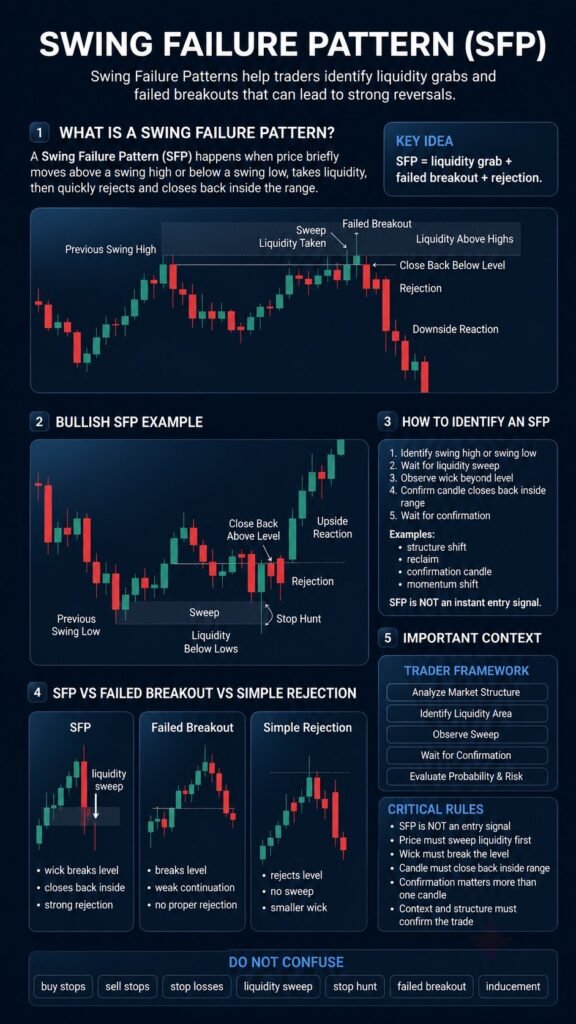
A Swing Failure Pattern, or SFP, happens when price moves beyond a key level, takes liquidity and quickly reverses back inside the range.
SFPs often appear near obvious highs or lows where many traders place stops or breakout orders.
How An SFP Forms
Most SFPs follow a simple process before the real move begins.
- Price approaches an obvious high or low
- Liquidity gathers around the level
- Price wicks through the level and takes liquidity
- Price quickly closes back inside the range
The wick traps traders. The reclaim often signals rejection.
SFP Trigger Logic
Sweep of high or low
+
Fast reclaim back inside
=
Potential SFP
This is not confirmation by itself. Wait for structure and context.
Why SFPs Matter
SFPs help traders identify failed breakouts and possible reversals.
- Captures liquidity before direction changes
- Shows rejection at important levels
- Often appears before CHoCH or BOS
- Can improve entry timing
Strong SFPs usually happen near key levels with confirmation.
How To Use SFP
- Identify an obvious swing high or swing low
- Wait for the liquidity sweep
- Look for reclaim and structure confirmation
- Enter after confirmation instead of reacting instantly
Context matters more than one candle.
Quick Recap
- SFP starts with a liquidity sweep
- The reclaim shows rejection
- CHoCH or BOS adds confirmation
- Best setups happen near important levels
- Smart money often takes liquidity before reversing direction.