Learn who controls private keys in exchange and self-custody wallets, how recovery works and what to check before moving crypto.

Crypto Custody: Exchange Accounts vs. Self-Custody
- Identify who controls each wallet’s signing keys.
- Check how lost access can be restored.
- Keep private keys and recovery phrases offline.
- Use official channels for support requests.
- Match the asset, address and network.
- Test unfamiliar transfer routes with small amounts.
This guide extends the published spot versus perpetual futures lesson into the separate question of how assets are held and accessed. It addresses custody risk rather than trade selection.
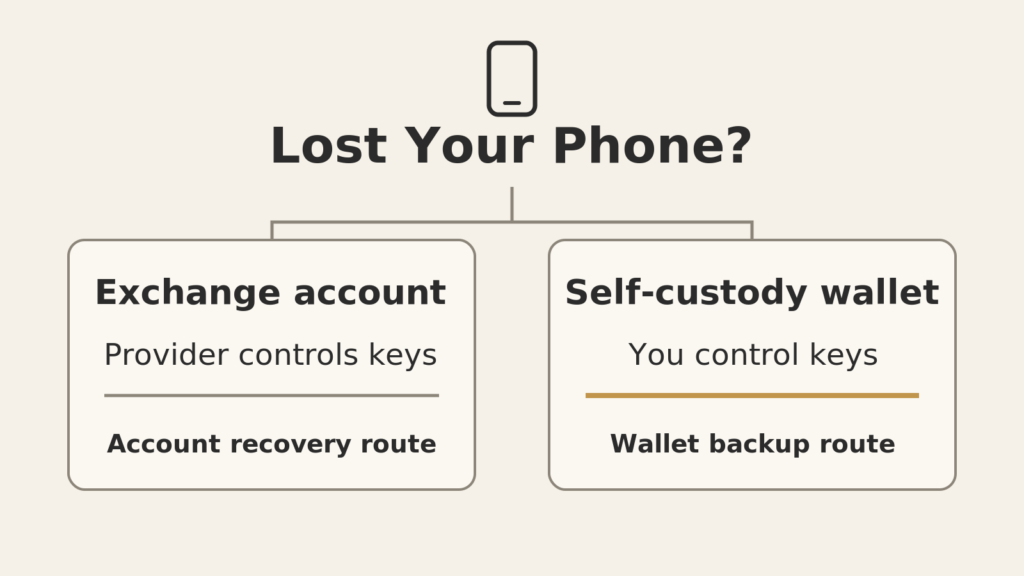
You lose your phone and suddenly cannot open your crypto app. If your coins are held on an exchange, the provider may have a way to verify your identity and restore account access. If the phone held a self-custody wallet, recovery depends on the backup or recovery method you set up. Neither path guarantees the return of stolen funds.
This difference explains crypto custody. It is about who can authorize transactions, who safeguards the private keys and who is responsible when access fails. An exchange account and a wallet you control can show the same amount of Bitcoin, but they put different responsibilities on you.
This guide compares both arrangements, explains the keys and recovery phrases behind them and follows the checks that matter before you move crypto between an exchange and a personal wallet.
Crypto Custody: What Changes Between an Exchange and Self-Custody?
The most useful question is who can authorize a transaction from the wallet holding the assets? With a typical custodial exchange account, the service manages the private keys and processes transactions under its systems and terms. You request withdrawals through your account rather than signing a blockchain transaction with keys that you personally hold.
With a typical self-custody wallet, you control the private keys or an equivalent signing arrangement. The wallet software helps you create and authorize transactions. The blockchain network then processes valid transactions under its rules. A provider cannot normally reset your missing private key simply because you can prove your identity.
The SEC’s December 2025 investor bulletin distinguishes third-party custody from self-custody by who controls the keys and who bears responsibility for them. It also makes a separate distinction between hot and cold wallets.
| Question | Exchange custody | Self-custody |
|---|---|---|
| Who controls signing keys? | Custodian or its providers | You or your chosen signing setup |
| How do you send assets? | Request a platform withdrawal | Authorize a wallet transaction |
| Who handles access recovery? | Provider under its account rules | You through your backup or recovery method |
| Main operational dependency | Provider security and availability | Key protection and recovery process |
| Can funds still be lost? | Yes | Yes |
This comparison describes the common models, not every product. Some services use shared signing arrangements, additional approval controls or different recovery systems. Read the actual account and wallet terms before assuming who has control.
What Does a Crypto Wallet Really Store?
A wallet does not hold Bitcoin inside an app like a file. Bitcoin is recorded by the network’s transaction system. The wallet manages the information needed to access and authorize activity involving that Bitcoin.
A private key is secret cryptographic information that can authorize transactions. A public address is information you can give to someone who wants to send an asset to your wallet on the supported network. A wallet may derive addresses from public-key information. These terms are related, but a public address is not the same thing as a private key.
In a common self-custody setup, the wallet generates a recovery phrase, sometimes called a seed phrase. It is a group of words that can restore the wallet’s keys. The phrase must remain private. Anyone who gets the usable recovery information may be able to move assets without knowing the device password.
Not all self-custody wallets use the same recovery design. Some use different backup methods or multiple signers. The reliable test is to understand the actual signing and recovery process, not to assume that every wallet must display the same number of words.
What Happens When Crypto Stays on an Exchange?
After an ordinary spot purchase on a custodial exchange, the platform credits your account with a crypto asset balance. The company manages the wallet infrastructure behind its service. Your account login gives you access to the platform’s functions, but it usually does not reveal a private key that you can use independently.
For many people, this setup is convenient. Trading, checking balances and requesting withdrawals can happen in one account. The provider may offer password resets, account verification and security controls. Those services are useful, but they are not equivalent to a promise that lost or stolen assets can always be restored.
Custodial accounts create counterparty risk. That means you depend on another organization to safeguard assets and honor its obligations. Cyberattacks, operational interruptions, account restrictions, insolvency or legal processes can affect access. The SEC investor bulletin identifies these concerns and recommends examining the custodian’s safeguards, terms and handling of customer assets.
A company might use pooled wallets, outside custody services or separate storage arrangements. An account balance alone does not tell you which setup applies or what legal claim you have if the provider fails. The answers depend on the provider, its terms and the applicable law. Do not assume every exchange account has bank-deposit insurance or an identical customer protection scheme.
Controlling signing keys changes who can authorize a transfer. It also changes who must safeguard the recovery method. A custody setup is incomplete until both responsibilities are clear.
What Changes When You Move to Self-Custody?
Moving crypto into a self-custody wallet changes how transfers are authorized. You no longer need the exchange to approve each transaction from your personal wallet under its withdrawal process. Your wallet instead uses the signing credentials you control.
This removes the particular dependence on that exchange for access to the withdrawn assets. It also removes much of the account recovery assistance associated with custodial services. If a device breaks, a correct backup may restore access. If the only valid recovery information is lost or stolen, the consequences may be permanent.
Self-custody does not make an asset independent of the blockchain or immune to other risks. You still rely on network operation and the security of your device, wallet software and any contracts you choose to interact with. A malicious transaction can be validly signed. A scam can exploit your permission to move tokens even when nobody steals a recovery phrase.
The key change is responsibility. You manage the signing authority and plan how access can be restored. This is an operational skill, not a trading signal or a guarantee that holding assets yourself is safer in every situation.
Why Is a Password Different From a Recovery Phrase?
An exchange password normally protects access to a user account. When the provider controls the custody system, it may offer password reset and identity verification. These functions depend on the service’s policies and do not guarantee the return of stolen funds.
A self-custody wallet password or device PIN often protects a local app or device. The recovery phrase can be more powerful because it may recreate the underlying signing keys on another compatible wallet. Changing a device PIN does not invalidate a recovery phrase someone else has copied.
Example: Your phone breaks. You have a compatible wallet and an accurate, securely stored recovery phrase. You may be able to restore access on a replacement device. Now consider losing both the device and the only recovery information. A customer support agent cannot simply issue new blockchain keys that recover control of the original address.
Bitcoin.org and the SEC both emphasize secure backups. The backup itself needs protection against theft, damage and accidental disclosure. Never enter a recovery phrase into a website or send it to someone claiming to provide support. A legitimate support process should not require you to reveal that secret.
Are Hot Wallets and Cold Wallets the Same as Custody Models?
No. Hot and cold describe how signing credentials are exposed to network-connected systems. Custodial and self-custodial describe who controls those credentials. They answer different questions.
A hot wallet is connected to the internet through software or a device. That can make frequent transactions convenient but can also increase exposure to online threats. A cold-storage design keeps private signing material away from internet-connected systems during normal storage. Hardware devices can use an offline signing component while a separate app prepares or broadcasts transactions.
An exchange can use both hot and cold storage while remaining the custodian. An individual can use an internet-connected self-custody wallet or a hardware wallet. Buying a hardware device does not, by itself, prove that keys were generated securely or backed up correctly.
Think of custody as the control decision and hot versus cold as one part of the security design. The SEC’s custody bulletin explicitly treats these as separate dimensions.
What Can Go Wrong During a Transfer?
Suppose you want to transfer a small amount of an asset from a custodial exchange to a personal wallet. A transfer may require the correct asset, the correct blockchain network and a valid receiving address. Some assets or destinations also require a memo or tag.
Different networks can use similar address formats. A displayed address alone may not prove that the destination supports the network you selected. The Coinbase Exchange transfer instructions tell customers to confirm the recipient’s supported network and warn that on-chain transfers are irreversible after processing.
A careful transfer review has six parts:
- Confirm the asset. Identify the actual token or coin and supported networks.
- Confirm the recipient. Obtain the address from the wallet you control or the intended recipient.
- Match the network. Check that sending and receiving sides support the same network.
- Check extra fields. Add a memo or destination tag when the receiving service requires one.
- Review the transaction. Recheck the complete address, amount, fees and destination before authorization.
- Verify the result. Confirm receipt using the receiving wallet and appropriate network record.
For unfamiliar transfer setups, a small initial transfer may reduce the amount exposed to a mistake. It cannot prove that every later transfer will succeed. Network fees, minimum withdrawal sizes and platform controls still apply.
Some chains and providers have limited recovery tools for certain mistakes. Those exceptions are not a reason to assume an incorrect transfer can be reversed. Treat the destination details as final once the transaction is authorized.
Lost Access: Which Recovery Route?
The device problem may look the same. The next step depends on who can authorize transfers and which recovery information is still available.
| Situation | What to check | Limit |
|---|---|---|
| Exchange login lost | Official account recovery | Provider may restrict access |
| Self-custody phone lost | Compatible wallet backup | Backup must be usable |
| Recovery phrase exposed | Secure new wallet and transfer plan | Funds may already be at risk |
| Wrong receiving network | Recipient support and transaction record | Recovery may be impossible |
Key distinction: Account recovery restores provider access. Wallet recovery restores signing access when valid backup information remains. Neither guarantees recovery of assets already stolen or misdirected.
What If Something Goes Wrong?
The right response depends on the type of problem. Four common situations reveal why custody and account recovery should not be treated as the same thing.
- Exchange login lost: Use the provider’s official account recovery route. Identity checks may restore access, but they do not resolve a withdrawal freeze or an insolvent provider.
- Self-custody device lost: Follow the wallet’s documented recovery process with a compatible backup. The missing device does not destroy the on-chain assets, but losing the only usable keys may make them inaccessible.
- Recovery phrase exposed: Treat it as compromised. A new device PIN does not make copied keys safe. Follow the wallet’s official guidance on moving assets to a newly secured wallet when that is still possible.
- Wrong receiving network: Stop repeating the transaction. Check the transaction record and the receiving provider’s official recovery policy. Some mistakes cannot be reversed or recovered.
Be skeptical of unsolicited recovery messages. A legitimate wallet provider cannot safely recover funds by asking you to reveal a secret recovery phrase.
How Should You Compare Exchange and Self-Custody Risks?
Both models can fail, but the failure paths differ. An exchange account depends on a provider’s systems and promises. Self-custody depends more directly on the integrity of your credentials, devices and recovery plan.
For exchange custody, investigate who actually holds assets, the service’s withdrawal restrictions, account security, customer asset treatment and available recovery channels. Read its terms and any relevant regulatory disclosures. Public registration or a security claim does not remove the possibility of loss.
For self-custody, review the reliability of your backup, the devices used for signing, the authenticity of the wallet software and the ability to recover after losing one device. An untested backup is an assumption, not a recovery plan. Keep recovery information private throughout the process.
Neither model prevents a crypto asset’s market price from falling. The spot versus perpetual futures guide distinguishes ownership of a spot asset from derivative exposure. This custody decision concerns access to that asset, not whether its price will rise or fall.
Can Two-Factor Authentication Protect a Self-Custody Wallet?
Two-factor authentication, often shortened to 2FA, adds a separate check when you sign in or approve certain actions. It is valuable for an exchange account because it can make account takeover harder. Some exchanges offer security keys, withdrawal allowlists and other controls.
A standard self-custody wallet is different. If someone obtains usable private keys or a recovery phrase, an exchange account’s 2FA setting does not protect that separate wallet. Device PINs, hardware signing and multi-signature arrangements may provide different safeguards, but their protection depends on the implementation.
Phishing remains a risk in both models. The FTC has documented fake wallet alerts designed to drive users to fraudulent websites. Treat unexpected requests to reveal a recovery phrase, sign an unfamiliar transaction or move funds for urgent account protection as a serious warning.
How Can a Beginner Review a Custody Setup?
Begin with the purpose of the funds. Assets used for frequent exchange trading may require a different access arrangement from assets kept for infrequent transfers. That is a planning distinction, not a recommendation for a particular wallet or exchange.
Use this short framework before relying on either model:
- Identify control. Who can authorize transfers with the relevant signing keys?
- Check recovery. What happens if you lose account access, the device or the backup?
- Test your understanding. Can you explain the difference between a password and a recovery phrase?
- Review dependencies. Which provider, network, device or software must remain available?
- Protect the credentials. What prevents an attacker or another person from gaining signing access?
- Plan transfers. How will you verify asset, address, network and any required memo?
The Risk Management Academy lesson introduces broader trading risk. Custody adds another form of risk, the possibility of losing access or transferring assets incorrectly without any change in market direction.
Common Crypto Custody Mistakes
- Confusing an exchange balance with private-key access. A custodial account can display assets without providing keys.
- Assuming a wallet holds coins inside the device. A wallet manages credentials that interact with a blockchain.
- Treating the recovery phrase like a resettable password. Copies of that phrase can remain usable after a device password changes.
- Assuming cold storage means self-custody. Both institutions and individuals can use offline storage.
- Rushing an on-chain transfer. Address, asset and network mistakes can be irreversible.
- Assuming personal key control removes every risk. Theft, malware, scams and operational mistakes still matter.
Choose a Custody Process You Can Explain and Maintain
Exchange custody places key management and much of the withdrawal process with a provider. Self-custody places transaction authorization and recovery responsibility in your hands. Both can be appropriate for different needs, but neither should be treated as automatically secure.
Before moving assets, identify who controls the keys, how access is recovered and what must happen for a transfer to succeed. A custody method is useful only when its actual responsibilities are understood and can be maintained.
Key takeaways
- An exchange balance does not give you independent signing keys.
- Self-custody transfers key security and recovery responsibility to you.
- A recovery phrase is not a resettable account password.
- Hot and cold storage describe security setups, not custody ownership.
- Neither custody model prevents market losses or transaction mistakes.
Control: Identify who authorizes an outgoing transfer.
Recovery: Name the backup or official recovery route.
Dependencies: List the providers, devices and networks involved.
Protection: Keep signing credentials and backups secure.
Transfer: Verify asset, receiving address and network.
Review: Confirm the result and update your recovery plan.
Sources
- U.S. SEC Investor.gov, Crypto Asset Custody Basics for Retail Investors, December 12, 2025. Key control, third-party custody, recovery obligations and hot versus cold storage.
- Ethereum.org, Frequently Asked Questions. Wallet and exchange recovery, irreversible transactions and seed phrase security.
- Bitcoin.org, Securing Your Wallet. Backups, offline signing and device-loss precautions.
- Coinbase Exchange Help, Depositing to Coinbase Exchange. Asset and network verification, test transfers and loss risks from incompatible deposits.
- U.S. Federal Trade Commission, What to Know About Cryptocurrency and Scams. Fraud, transfer finality and recovery limitations.
Custody protects access, not the market value of the asset. Explore the lessons on risk, orders and position exposure.