Learn how margin and liquidation work in crypto futures, with clear examples of collateral, initial margin, maintenance margin and forced exits.

Margin and Liquidation in Crypto Trading: What Beginners Need to Know
- Identify the contract and margin mode.
- Record the full position notional.
- Check initial and maintenance requirements.
- Review mark price and liquidation rules.
- Assess stops, costs and shared collateral.
This beginner guide follows the published spot versus perpetual futures and order types articles. It explains the margin mechanics that govern forced closure before the later topic on liquidation cascades.
A $1,000 perpetual futures position can be liquidated while part of its $200 collateral is still available. The exchange does not wait for the balance to reach zero. It checks how much equity remains against the minimum needed to keep the position open.
Margin and liquidation in crypto trading explain how much collateral supports a leveraged position and what can happen when that collateral no longer meets an exchange’s requirements. Margin is not the same as the amount at risk. Liquidation is not the same as a planned stop-loss exit.
This guide starts with five basic terms, follows one illustrative position through a price decline and compares isolated with cross margin. It also explains why a displayed liquidation price cannot be treated as a universal formula or guaranteed exit price.
What Are Margin and Liquidation in Crypto Trading?
Margin is collateral used to open or support a leveraged trading position. Leverage means the position’s market exposure is larger than the collateral allocated to it. A futures exchange sets margin rules so positions can absorb some losses and still meet the platform’s financial obligations.
Liquidation is a forced reduction or closure of a position by the exchange’s risk system. It can begin when the account or position no longer meets required margin conditions. The exchange does not need to follow your original trading plan to begin this process.
These rules mainly matter for derivatives and borrowed positions. An ordinary fully funded spot purchase has price risk but does not face perpetual futures margin liquidation. The spot versus perpetual futures guide explains the difference between owning a crypto balance and holding a contract.
Not all products follow the same rules. Futures, perpetual contracts, borrowed spot positions and portfolio margin arrangements can use different collateral calculations. Always identify the exact product first.
Five Terms You Need Before Reading a Liquidation Screen
Position notional is the value of the market exposure. Initial margin is the collateral required to open a position. Maintenance margin is the minimum collateral support the exchange requires to keep the position open. Equity is the value available to support positions after relevant balances and gains or losses are considered. Liquidation price is an exchange-calculated trigger level under specified account conditions.
The distinction between the first two margin requirements matters. Initial margin determines how much capacity you need to open exposure. Maintenance margin determines when your remaining support becomes insufficient. Kraken’s derivatives documentation describes those as different requirements with different consequences.
| Term | Question it answers | Important limit |
|---|---|---|
| Position notional | How much market exposure do I control? | Not the same as cash deposited |
| Initial margin | What collateral is needed to open? | Not a fixed maximum loss |
| Maintenance margin | What support must remain? | Depends on venue and risk tier |
| Equity | What value supports my positions now? | Can change with losses and costs |
| Liquidation price | Where can forced closeout begin? | May change with account conditions |
On an exchange screen, maintenance margin might appear as a dollar requirement or as a margin ratio. The exact definition of that ratio can differ across platforms. Never assume that a higher displayed percentage means the same thing on every exchange.
How Does a $1,000 Position Change When Price Falls?
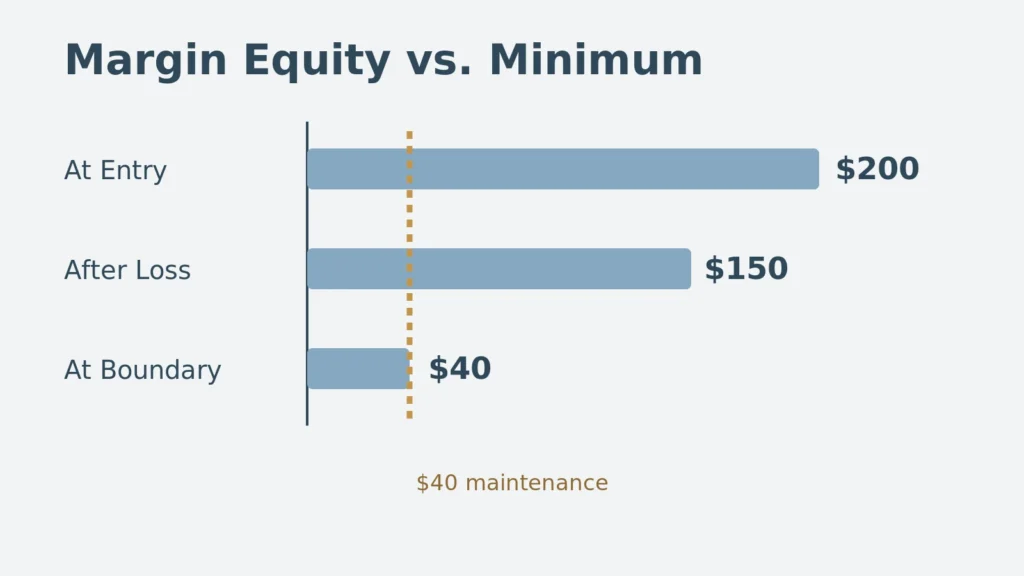
Consider an entirely illustrative linear perpetual futures position. A trader opens a $1,000 long position with $200 in collateral. That is 5x exposure relative to the initial collateral. We assume a 5% adverse change in the underlying contract price and no fees, funding payments or other positions.
The position loses approximately $50, calculated as 5% of $1,000. The simplified remaining equity is $150, calculated as $200 minus $50. The position still represents market exposure. Its value can continue to change after that point.
For a visual teaching example, assume the maintenance requirement is a fixed $40 at this observation. The simplified cushion above that requirement is $110, or $150 minus $40. The cushion is not spendable profit. It represents space between current equity and the assumed threshold in this deliberately simplified example.
These numbers are not an exchange’s maintenance formula and do not calculate a real liquidation price. Actual maintenance requirements can vary with the mark price, position size, risk tier, fees, funding and other account balances. The example teaches why a loss can shrink margin support well before the position reaches zero equity.
A position does not need to reach zero collateral before forced reduction begins. The relevant question is whether the equity available to support that position or account meets its maintenance requirement. Adding collateral may increase the buffer, but it can also increase the funds exposed to further loss.
How Much Margin Buffer Remains?
The margin buffer is the amount of eligible equity above the relevant maintenance requirement, measured for the same position or account. In the example above, the buffer is $200 minus $40, or $160, at entry. After the $50 loss it is $150 minus $40, or $110. The buffer can reach zero while the position still has positive equity.
For example, if a cross-margin account has $40 above its combined maintenance requirement, another $30 loss on an open position would reduce that buffer to $10, assuming no other changes. That loss can increase liquidation risk for several positions at once. Do not compare the equity of one position with the maintenance requirement of a different account scope.
Why Is Initial Margin Different From Maintenance Margin?
Imagine initial margin as the collateral needed to enter a contract and maintenance margin as the support needed to keep it open. The two requirements serve different stages of the position.
If a trader has too little initial margin, the platform may refuse a new position or an order that increases exposure. If the relevant account or position falls below maintenance margin, its risk system may start forced reduction or liquidation. Kraken describes this separation in its derivatives margin documentation. The exact actions vary by product.
Maintenance margin is not necessarily a constant percentage of the original deposit. Exchanges can use risk tiers, position size, current notional value and available collateral. Some products also reserve possible closing fees. A beginner should treat the exchange’s own position detail screen and official contract specification as the relevant source.
A key implication follows: liquidation can begin before a position has lost all of its collateral. The exchange seeks to reduce the chance that further losses exceed the available support. Rapid price moves can still create a deficit or a worse result than the initial estimate.
What Is the Difference Between Isolated and Cross Margin?
Isolated margin allocates collateral to a specific position. The exchange assesses that position against its assigned support. If the position reaches its liquidation threshold, its own allocated collateral is the primary amount exposed under that mode. Traders can sometimes add collateral manually, and some platforms offer automatic additions that change the amount at risk.
Cross margin shares eligible collateral across multiple positions or an account pool. Profits and spare collateral from one position can help support another position. The same connection means one losing position can reduce support for other positions. The risk may spread beyond the funds a trader mentally assigned to a single trade.
Bybit’s Unified Trading Account documentation distinguishes position-specific isolated liquidation from broader cross-margin account checks. Kraken also documents separate liquidation behavior under these modes.
Neither mode is automatically safe. Isolated margin can be liquidated sooner when little collateral is allocated. Cross margin can delay liquidation using more eligible collateral but also expose a larger portion of the account. Some exchanges offer portfolio margin as a third approach with its own models.
Before selecting a mode, read which balances can be used, whether collateral can move automatically and what happens to other open positions during forced liquidation.
How Does an Exchange Decide to Liquidate a Position?
An exchange tracks the financial support behind each relevant position or account. It checks unrealized profit and loss, eligible collateral and required maintenance margin. For some futures products, the trigger is based on a mark price, not the most recent price traded on the chart.
Mark price is a calculated reference used by the platform for tasks such as unrealized profit and loss or liquidation checks. A last traded price is the price of the most recent transaction. Binance and Bybit document liquidation triggers using mark price for specified futures contracts.
That difference can explain why a platform shows a liquidation event even when a default candle chart does not visibly touch the displayed level. The chart may show last traded prices instead of the exchange’s liquidation reference.
When a threshold is reached, exchanges can cancel risk-increasing orders, reduce position size or close a position. Bybit documents partial reductions for some higher risk tiers. Binance also documents staged liquidation procedures. Do not assume all positions are always closed immediately in one trade.
A liquidation is an automated risk response. It is not proof that the original trading idea was wrong, nor does it mean the trader selected a precise market exit price.
Margin Buffer: A Worked Example
Illustrative $1,000 perpetual long. Start with $200 position collateral and assume an unchanged $40 maintenance requirement. Fees and funding are excluded.
| Snapshot | Position loss | Margin equity | Above maintenance |
|---|---|---|---|
| At entry | $0 | $200 | $160 |
| After 5% price drop | $50 | $150 | $110 |
| At the assumed boundary | $160 | $40 | $0 |
Model only: Margin buffer = eligible equity minus maintenance requirement. Real exchanges use contract-specific formulas, risk tiers, mark prices and costs. This table does not predict any exchange’s liquidation price.
Why Is the Liquidation Price Not a Guaranteed Exit?
The number shown as liquidation price is a threshold estimate based on the platform’s rules and current account conditions. It is not a price at which the exchange guarantees to sell or buy the entire position.
Fast markets can move between reference prices and available executable quotes. Risk tiers, fees, funding and other positions may also affect the threshold. For cross margin accounts, changes elsewhere in the account can alter available support even when one contract’s market price barely moves.
The exchange may execute forced orders at different prices after the liquidation process begins. A displayed threshold and a final realized loss are separate values. Contract rules can also describe liquidation fees, insurance arrangements or deficit treatment.
For this reason, do not turn a simple leverage calculation into an exact liquidation prediction. A statement such as “5x means liquidation after a 20% move” ignores maintenance margin and other requirements. A trader may face liquidation earlier, or account conditions may change the outcome.
Can a Stop-Loss Order Prevent Liquidation?
A stop-loss order can be part of a planned exit, but placing one does not guarantee that a position will be closed before liquidation. A stop-market order must trigger and then find executable liquidity. A stop-limit order can trigger without filling at all when its price condition is not met.
A rapid price move, a difference between stop trigger and liquidation reference prices or the platform’s order rules may cause the liquidation process to begin before a protective order fills. Trigger price and execution price are different. The market, limit and stop orders guide explains that distinction with a simple example.
There is also a practical difference between a voluntary exit and forced closeout. Voluntary closure follows a trader’s order instructions, subject to available liquidity. Liquidation follows the exchange’s collateral rules. Neither mechanism promises a specific final price.
The safest way to read an order ticket is to separate three questions: What should trigger my order? What conditions could prevent a fill? What happens if the account reaches its maintenance threshold first?
What Happens to Collateral During Liquidation?
Liquidation can use the remaining collateral to absorb losses and account for applicable fees. The platform may close only enough of a position to restore required support, or it may close the whole position. Which path applies depends on the contract and liquidation process.
In isolated mode, the collateral assigned to the affected position is the main pool at risk under the documented isolated rules. Additional collateral transfers or automatic top-up settings can increase that exposure. In cross mode, eligible shared collateral can support other positions and can also be consumed as losses expand.
It is misleading to promise that a trader can lose only the initial margin in every situation. Different legal and clearing arrangements may handle deficits differently. The CFTC warns that margined futures losses can exceed initial investment in some arrangements. Stablecoins and other collateral assets can also change in value.
Record the platform’s actual liquidation fee, deficit terms and collateral policy. These details matter more than the selected leverage level alone.
How Should a Beginner Review Margin Risk Before Opening a Position?
A simple review can reveal problems that a price chart cannot show. Use the actual contract details, not a generic calculator copied from another exchange.
- Identify the contract. Confirm whether you are trading spot margin, a linear perpetual or another derivatives product.
- Read the exposure. Compare notional position value with the collateral supporting it.
- Find both requirements. Record initial margin, maintenance margin and any applicable risk tier.
- Confirm the margin mode. Identify the eligible collateral pool and automatic transfer settings.
- Check the trigger reference. Determine whether the platform uses mark price, account equity or another documented test.
- Check the order rules. Review how stops, partial fills and forced closeout interact.
- Review the possible loss. Include trading fees, funding costs and collateral changes under an adverse scenario.
For position sizing, begin with the amount of money your trading plan can risk on a decision rather than the maximum leverage the venue permits. The position sizing guide develops that separate process. The risk of ruin guide explains why repeated exposure can threaten capital even when individual trades appear manageable.
Common Mistakes About Margin and Liquidation
- Confusing margin with position size. A $200 deposit can support more than $200 of exposure.
- Confusing initial with maintenance margin. One helps determine entry capacity and the other supports an open position.
- Assuming isolated margin has no extra risk. Automatic or manual additions can raise the capital committed to a position.
- Assuming cross margin protects every position. Losses can draw on shared collateral and affect unrelated positions.
- Using a last-price chart as the liquidation reference. Some contracts use mark price instead.
- Taking a displayed liquidation price as an exit guarantee. Forced execution can happen at a different price.
- Treating a stop as guaranteed protection. Triggering an order and filling it are separate events.
Understand the Margin System Before the Trade
Margin determines what collateral supports your exposure. Initial margin helps determine whether you can open a position. Maintenance margin helps determine whether you can keep it open. Liquidation is the exchange’s response when required support is no longer available.
The practical lesson is to monitor exposure, equity, maintenance requirements and margin mode together. A simple price chart or leverage number cannot show the full account risk. Check the product’s documented rules and the actual fill records before drawing conclusions about what an exit will cost.
Key takeaways
- Initial and maintenance margin are different requirements.
- Liquidation can start while margin equity is positive.
- Cross margin shares eligible collateral across positions.
- A stop instruction cannot guarantee an exit before liquidation.
- Displayed liquidation prices depend on changing account conditions.
Scope: Identify one position or shared margin account.
Equity: Record currently eligible supporting funds.
Minimum: Check maintenance margin for that scope.
Buffer: Subtract the minimum from current equity.
Trigger: Confirm the mark price and risk rules.
Exit: Check stop order behavior and closing costs.
Sources
- Kraken, Leverage and Margining in Derivatives. Definitions of initial margin, maintenance margin and forced account actions.
- Bybit, Trading Rules: Liquidation Process. Differences between margin modes, mark price triggers and partial liquidation.
- Binance, Futures Liquidation Protocols. Mark price, margin conditions and staged liquidation.
- Coinbase, Leverage and Margin Rates for Futures. Account equity and maintenance margin ratios for specified futures products.
- CFTC, Understand the Risks of Virtual Currency Trading. Risks of leverage and possible losses beyond initial funds in some futures arrangements.
Margin rules help you understand when a platform can take control of an open position. Continue with the Nobilora Free Lessons to build a documented risk and execution process.