Understand why trading losses require larger percentage gains to recover, how drawdowns affect account equity and how to manage recovery pressure.

Drawdown Recovery: Why Losses Need Bigger Gains
- Measure drawdown from peak account equity.
- Calculate the recovery gain before reacting.
- Define risk per trade before entering.
- Set drawdown review limits in advance.
- Review losing sequences and execution errors.
- Never increase size solely to recover losses.
Drawdown recovery connects simple percentage mathematics with practical capital protection. Understanding the relationship helps traders evaluate cumulative losses without allowing recovery targets to dictate their next trading decision.
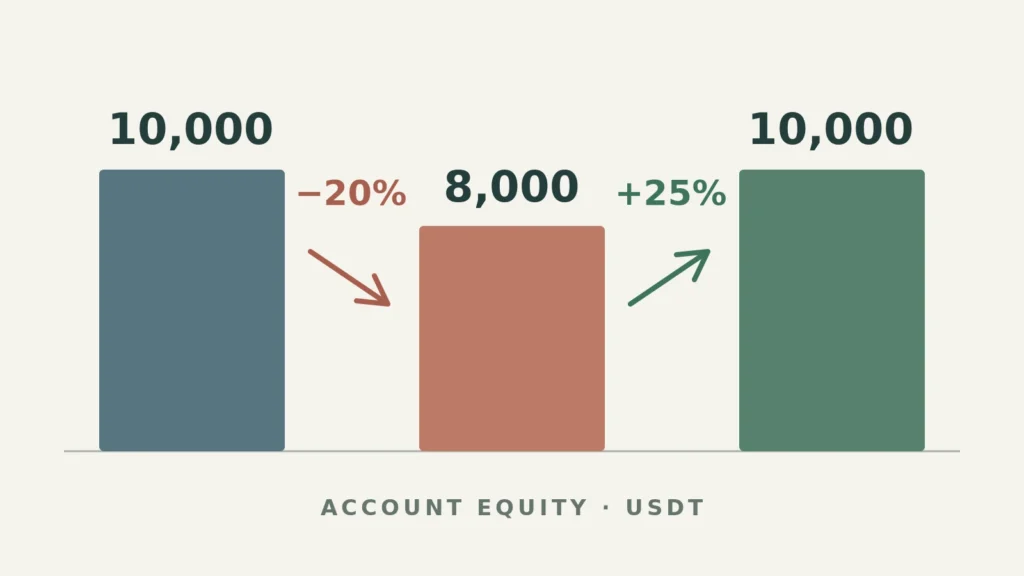
Drawdown recovery starts with a simple mathematical fact. A 20% trading loss is not recovered by a 20% gain. Once an account loses 20% of its value, it needs a 25% gain to return to its previous level.
This difference is the foundation of drawdown recovery. Losses reduce the account balance on which future gains are calculated. As losses become larger, the percentage gain needed to recover grows disproportionately.
Understanding this relationship helps beginners see why capital protection matters, how drawdowns affect account equity, and why trying to recover losses too quickly can create additional risk.
What Is a Trading Drawdown?
A trading drawdown is a decline in account equity from a previous peak. It measures how far an account has fallen relative to its earlier high.
Suppose an illustrative account reaches $12,000 and subsequently declines to $9,000. The decline is $3,000, or 25% of the previous peak.
The account has therefore experienced a 25% drawdown.
Drawdown is measured from the relevant equity peak, not necessarily from the original deposit. An account can remain above its starting balance while still experiencing a drawdown from a higher value reached later.
For accounts with open positions, marked-to-market equity can also decline before a trade is closed. The calculation should consistently use the same account value measure.
Why Drawdown Recovery Requires Bigger Gains
The key difference comes from the base used to calculate each percentage.
Imagine an illustrative account starting at $10,000.
After a 20% loss, the account contains $8,000. Returning to $10,000 requires a gain of $2,000.
But $2,000 is now 25% of the remaining $8,000, not 20%.
This is why equal percentage losses and gains do not cancel each other out.
The effect becomes more pronounced as the drawdown deepens. A 50% loss leaves half the original account value. Returning to the previous peak requires doubling what remains, which is a 100% gain.
The Drawdown Recovery Formula
The required recovery gain can be calculated using the drawdown expressed as a decimal.
Required recovery gain = drawdown / (1 – drawdown) × 100%
For a 20% drawdown, substitute 0.20 into the formula.
0.20 / 0.80 × 100% = 25%
The formula assumes the account is recovering through investment or trading gains without additional deposits, withdrawals, or other balance adjustments.
The following table shows the mathematical recovery requirement at different drawdown levels.
| Drawdown | Gain Needed to Recover |
|---|---|
| 5% | 5.3% |
| 10% | 11.1% |
| 20% | 25.0% |
| 25% | 33.3% |
| 30% | 42.9% |
| 40% | 66.7% |
| 50% | 100.0% |
| 75% | 300.0% |
All values are illustrative mathematical results, rounded to one decimal place where necessary. They are not performance expectations.
A percentage loss reduces the account equity on which future gains are calculated. The deeper the drawdown, the larger the percentage gain required to recover. Risk limits should be defined before losses occur, not adjusted impulsively to meet a recovery target.
Why the Recovery Gap Grows
At smaller drawdowns, the required recovery gain is only moderately larger than the original loss.
A 5% drawdown requires approximately 5.3% to recover. A 10% drawdown requires approximately 11.1%.
At a 30% drawdown, however, the required gain reaches approximately 42.9%. At 50%, the remaining equity must increase by 100%.
A 75% drawdown leaves only one-quarter of the original account value. Returning to the previous peak requires a 300% gain on what remains.
The mathematical lesson is not that small losses are harmless. It is that allowing losses to compound can make the recovery requirement increasingly demanding.
What Is Maximum Drawdown?
Maximum drawdown is the largest observed peak-to-trough percentage decline in account equity during a specified measurement period.
Suppose an illustrative account reaches $15,000, declines to $12,000, recovers to $14,000, and later falls to $10,500.
The largest decline from the earlier $15,000 peak to $10,500 is 30%. If no larger peak-to-trough decline occurred during the period, the maximum drawdown is 30%.
Maximum drawdown helps describe the severity of historical account declines. It does not establish a limit on future losses.
The result also depends on the period measured and whether the calculation uses closed-trade balances or account equity that includes unrealized gains and losses.
Drawdown Recovery and Risk Per Trade
Risk per trade describes the amount a trader plans to lose if one position reaches its invalidation level. Drawdown describes the cumulative decline of the account from a previous peak.
Several trades can follow individual risk limits and still produce a meaningful account drawdown.
Consider a hypothetical trader risking 1% of current equity on each trade. If ten consecutive trades each lose exactly that amount, the account declines by approximately 9.6%.
If the same sequence instead risks 5% of current equity per trade, the cumulative decline is approximately 40.1%.
These calculations assume that each loss is exactly the specified percentage of equity immediately before the trade, with no additional execution costs or other account changes.
The percentages are examples, not recommended risk settings. Their purpose is to demonstrate how position risk affects cumulative losses.
The Nobilora risk management lesson explains how individual trade limits fit into a broader capital protection process.
Recovery Pressure Can Change Trading Decisions
Drawdowns create a mathematical problem and may also create behavioral pressure. Behavioral-finance research documents biases such as loss aversion, overconfidence and regret aversion. These findings describe possible decision tendencies, not a prediction about every trader.
After several losses, a trader may begin focusing on the amount required to return to the previous equity peak rather than on the quality of the next opportunity.
For some traders, that pressure may contribute to larger positions, weaker trade selection, premature exits or attempts to recover within an arbitrary deadline. The specific response varies and cannot be inferred from a drawdown figure alone.
None of those actions changes the recovery formula. They can, however, increase exposure to further losses.
Understanding the fear and greed cycle and maintaining trading discipline can help traders recognize when the desire to recover is beginning to influence their decisions.
Why a 50% Loss Needs a 100% Gain
Starting equity: $10,000.
After a 50% drawdown: $5,000 remains.
After a 50% gain: The account reaches only $7,500.
Required recovery: A 100% gain on the remaining $5,000 restores the original $10,000.
The percentages use different account balances. That is why an equal percentage gain cannot reverse the original loss.
Why Increasing Position Size After Losses Is Risky
A trader experiencing a 20% drawdown needs a 25% gain to recover the previous equity peak.
Increasing position size might appear to offer a faster recovery. But larger exposure also increases the potential loss if the next trade moves against the position.
A deeper loss then creates an even larger percentage recovery requirement.
Changing risk after a drawdown is not automatically inappropriate. Some trading plans use predefined rules to adjust exposure as account equity changes.
The distinction is whether the adjustment follows a documented risk framework or an emotional attempt to recover losses quickly.
How Beginners Can Manage Trading Drawdowns
Define Risk Before Entering a Trade
Determine how much account equity can be exposed before placing a position. The planned loss should reflect the trade structure and the account’s risk framework.
Actual losses may exceed planned amounts because of gaps, slippage, liquidity conditions, or other execution effects.
Track Equity Peaks and Declines
Record the highest relevant account equity and measure subsequent declines against that peak.
Use a consistent calculation method so drawdown measurements remain comparable over time.
Set Review Limits in Advance
A trading plan can define when a drawdown triggers a pause, risk review, or position-size adjustment.
There is no universal percentage suitable for every trader. Limits should reflect the strategy, instrument, account circumstances, and acceptable risk.
Review Losing Sequences
Separate losses that occurred while following the trading plan from losses caused by execution mistakes or broken rules.
A losing sequence does not automatically prove a strategy is ineffective, but it provides information that deserves review.
Keep Recovery Targets Separate From Trade Selection
The gain required to recover is a mathematical measurement. It should not become a reason to take a trade that fails the strategy’s normal criteria.
Document drawdown rules and reviews in a trading plan and journal.
Common Drawdown Recovery Mistakes
- Assuming equal percentages cancel out. A 30% loss requires approximately a 42.9% gain to recover.
- Measuring from the original deposit. Drawdown should be measured against the relevant previous equity peak.
- Ignoring unrealized losses. Open positions can affect current account equity before they are closed.
- Increasing risk to recover faster. Larger exposure can deepen an existing drawdown.
- Setting limits after losses occur. Risk rules are easier to evaluate consistently when defined before the drawdown.
- Treating historical maximum drawdown as a guarantee. Future losses can exceed previously observed declines.
A Practical Drawdown Recovery Checklist
- Identify the equity peak. Find the highest relevant account value during the measurement period.
- Calculate the drawdown. Measure the percentage decline from that peak.
- Calculate the required recovery. Apply the recovery formula to the remaining equity.
- Check current exposure. Review open positions and planned risk per trade.
- Review the losing sequence. Identify whether trades followed the strategy and execution rules.
- Apply predefined limits. Follow the trading plan’s rules for review, pauses, or exposure adjustments.
- Evaluate the next trade independently. Do not let the recovery target determine whether a setup is valid.
Protecting Capital Changes the Recovery Problem
Drawdown recovery is not symmetrical. Every percentage loss reduces the equity base from which future gains are calculated.
As drawdowns become deeper, the percentage gain required to return to the previous peak increases.
This does not mean every drawdown can be avoided or every account can recover. It means cumulative losses, position risk, and trading discipline deserve attention before recovery pressure becomes the main driver of decisions.
A trading plan should determine how risk is managed. The amount needed to recover should remain a measurement, not a reason to abandon that plan.
Key takeaways
- A percentage loss requires a larger percentage gain to recover.
- Drawdown is measured from a previous equity peak.
- Deeper drawdowns increase the recovery requirement disproportionately.
- Risk per trade and total account drawdown are different measures.
- Recovery pressure should never replace predefined trading rules.
Identify peak equity: Record the previous account high.
Measure drawdown: Calculate the percentage decline from that peak.
Find remaining equity: Subtract the drawdown percentage from 100%.
Calculate recovery: Divide the drawdown percentage by the remaining equity percentage.
Example: 20% / 80% × 100 = 25%.
Review risk: Compare the current drawdown with your predefined trading plan.
Sources
- CFA Institute, The Behavioral Biases of Individuals, 2026 Curriculum. Loss aversion, overconfidence, regret aversion and their possible effects on investment decisions.
- Garvey, R. and Murphy, A., Are Professional Traders Too Slow to Realize Their Losses?, Financial Analysts Journal (2004). Evidence of delayed loss realization in a specific professional trading sample.
Drawdown control is one part of a complete trading process. Continue with Nobilora Free Lessons to connect capital protection, trading discipline and structured decision-making.