Perpetual funding transfers money between long and short holders. Learn to calculate payments, compare contract rules and evaluate position costs.

Perpetual Futures Funding Rates: Costs and Positioning
- Confirm the contract and settlement method.
- Check which side pays at the final rate.
- Calculate funding using full position notional.
- Compare rates on a common time basis.
- Include funding in the net trade record.
- Stress unfavorable rates and collateral needs.
The Open Interest Academy lesson covers outstanding derivatives exposure. This article explains the funding cash flows and the effect on holding a perpetual futures position.
A perpetual futures trade can move in the expected direction and still earn less than its price chart suggests. The position may incur a funding payment during the holding period, even when no new order is placed. A trader receiving funding faces the opposite problem: the payment looks attractive, but the underlying position can lose far more from price movement.
Perpetual futures funding rates determine transfers between long and short positions under an exchange’s contract rules. They help discourage persistent differences between the perpetual price and a reference spot index. Funding affects the net economics of holding a position, but it does not guarantee where price will move next.
This guide explains who pays, how to calculate a funding payment, why settlement methods vary and what the rate can and cannot tell you about market positioning. A hypothetical example makes the cash flows explicit without assuming current market prices or live funding rates.
What Are Perpetual Futures Funding Rates?
A perpetual futures contract is a derivative that gives long or short exposure to an underlying asset without a fixed expiry date. Its price can trade above or below a reference index drawn from spot markets. Unlike a dated futures contract, a perpetual does not converge toward a contractual expiration price on a specified maturity date.
Funding is one mechanism designed to keep that perpetual price linked to its reference. Under common exchange models, the funding transfer moves value from one side of the market to the other. It does not represent a change in the asset’s spot price or a dividend paid by the underlying asset.
The mechanism is separate from the fee charged to open or close a trade. Trading commissions arise from executing orders. Funding is associated with maintaining an eligible position under the contract’s funding rules. Some venues explicitly describe the transfer as passing between long and short holders without an extra platform funding charge.
There is no single funding formula or universal settlement schedule for every perpetual. The reference index, premium calculation, interest component, rate limits and timing depend on the product and venue. Read the specific contract documentation before translating a displayed percentage into an expected cash flow.
He, Manela, Ross and von Wachter study the relationship between funding and perpetual pricing. Their research explains why recurring transfers influence the perpetual-spot gap without making exact convergence or profitable arbitrage automatic.
Who Pays When Funding Is Positive or Negative?
For conventional perpetual futures funding, a positive rate means longs pay shorts. A negative rate means shorts pay longs. A zero rate means no transfer from the rate component at that calculation point, subject to the venue’s settlement rules. The sign indicates payment direction, not whether holding a long or short will be profitable overall.
For example, a trader long at a positive rate may benefit from a rising contract price but pay funding. A trader short at the same rate may receive funding while losing much more if the contract rises. Receiving a transfer does not hedge the trade’s directional price risk.
When the rate changes sign, the funding direction can reverse. If a trader holds through several calculations, some payments may be debits and others credits. The realized funding total is the sum of the actual intervals or accrual amounts, not the rate first displayed on entry multiplied by an arbitrary holding period.
How Is a Funding Payment Calculated?
For a simple linear, quote-currency-settled perpetual at a discrete funding event, the basic calculation is funding transfer = position notional value multiplied by the funding rate for that event. On venues using a mark-price-based notional, position value is contract quantity times the mark price, with contract specifications applied. The sign determines which side pays and which receives.
Assume a hypothetical linear position has a $20,000 notional value at settlement. Suppose the event’s final funding rate is +0.01%. Convert the percentage to decimal form: 0.01% is 0.0001. The transfer magnitude is $20,000 multiplied by 0.0001, or $2. A long pays $2 and a short of equal notional receives $2 under this simplified two-sided model.
| Illustrative settlement rate | Long position | Short position |
|---|---|---|
| +0.01% | Pays $2 | Receives $2 |
| -0.01% | Receives $2 | Pays $2 |
| 0.00% | No transfer | No transfer |
The $20,000 size and both rates are invented for education. They are not a funding quote from any exchange. This example assumes matching long and short notional, a fully paid transfer and no contract-specific rounding or restrictions. Inverse or coin-settled contracts can express position value and payments in a different unit.
Some products use continuous accrual instead of a discrete event. In that case, the same economic idea applies, but the rate must be adjusted to the time fraction and changing notional specified by the venue. Never apply an eight-hour quoted rate as though it were a separate hourly payment.
A positive funding rate identifies the paying side under the contract rules. It does not tell you whether price will rise or fall next. A trader receiving funding can still lose far more from price movement or collateral stress than the transfer provides.
How Do Funding and Leverage Affect Position Costs?
Funding is commonly calculated from position notional, not the initial margin deposit. Suppose the hypothetical $20,000 position uses $2,000 in initial margin. The +0.01% event still produces a $2 funding debit for the paying side, not $0.20. Relative to that $2,000 deposit, the $2 transfer equals 0.10% for the event.
Leverage does not create a second funding multiplier after notional is calculated. It changes how much collateral supports a given position, so the same absolute funding amount can represent a larger share of posted margin. Higher notional at the same funding rate creates a larger transfer. These are different relationships.
Repeated debits can reduce available balance or margin, depending on the product’s accounting rules. Bybit documents that insufficient available balance can cause funding to be drawn from position margin and move an isolated position closer to liquidation. Mark-price changes, maintenance requirements and other positions also affect actual liquidation exposure.
The position sizing guide explains the difference between a planned loss budget and position quantity. Funding adds a separate holding-period cash flow. Neither one substitutes for an analysis of price and liquidation risk.
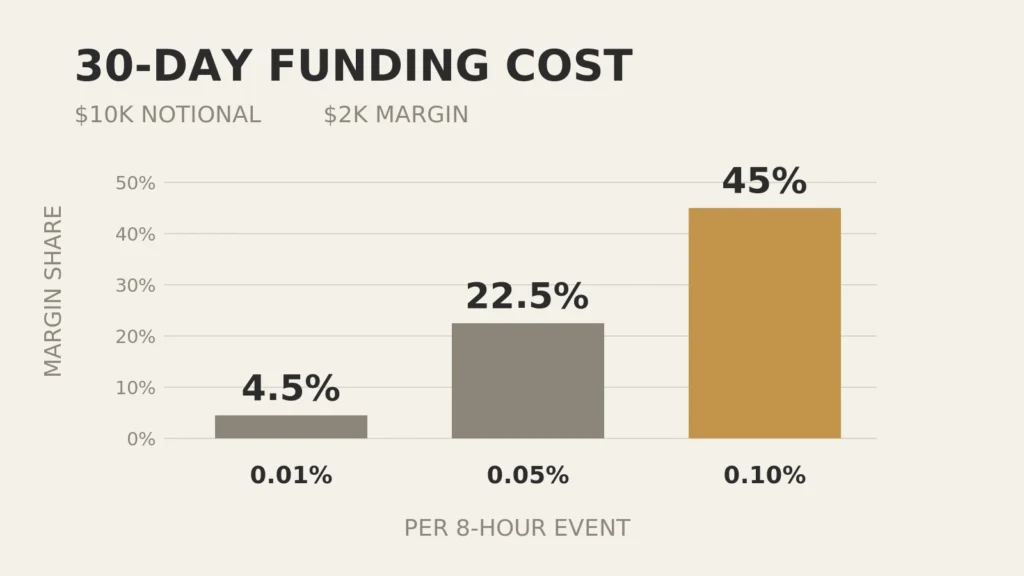
A 30-day holding-cost example: Assume a $10,000 linear perpetual long backed by $2,000 in initial margin. If the contract settles every eight hours and a constant positive rate applies at all 90 events across 30 days, the long pays $90 at 0.01%, $450 at 0.05% or $900 at 0.10% per event. These amounts equal 4.5%, 22.5% and 45% of starting margin. The rates and notional are assumed constant solely for this calculation. Real funding changes and these figures exclude price movement, fees and liquidation effects.
When Does Funding Accrue or Settle?
For many traditional crypto perpetuals, a trader owes or receives a transfer only if the position is open at a scheduled funding timestamp. Bybit documents this rule for its contracts and notes that eligible pairs can have different funding intervals. An eight-hour schedule is a common example, not an industry-wide constant.
Assume the hypothetical $20,000 position remains unchanged across three eight-hour settlement events, each with a final rate of +0.01%. A paying long would owe $2 at each event, or $6 across the three events. The same short would receive $6 under the simplified assumptions. In a live market, the rate, mark price and position size can change between events.
Other contracts handle accrual differently. Coinbase’s Global Derivatives documentation states that its displayed funding rate is expressed as an eight-hour rate while payment accrues continuously and is incorporated into realized session profit and loss. A position held for only part of the quoted eight-hour period receives a proportional treatment under that product’s rules.
Funding calculation, cash accrual and final cash-balance settlement are not always the same event. The exchange may display an estimated upcoming rate before it becomes final. Bybit states that the displayed upcoming rate may change up to the funding timestamp. Trading just before a scheduled event does not reliably lock in a projected rate, and execution and processing timing can matter.
Compare funding rates on the same time basis. A rate of 0.01% every eight hours and a rate of 0.01% every hour are not economically equivalent over a full day. Also distinguish a displayed eight-hour equivalent from an amount actually charged every eight hours. The product’s rules determine the calculation.
What Determines the Funding Rate?
Funding formulas commonly respond to the relationship between a perpetual contract and a reference spot index. A perpetual trading at a premium can contribute toward positive funding, which gives longs an incentive to reconsider paying to hold their exposure and can reward shorts. A discount can contribute toward negative funding. This is an incentive mechanism, not a guarantee that the contract will converge immediately.
Index price represents the reference market value constructed under venue rules. Mark price is a separate valuation measure used by some venues for margin, liquidation calculations or funding notional. Premium index can measure the futures-versus-index difference using impact prices rather than a simple last traded price. Do not assume these three values are identical.
Bybit’s published method combines a premium index with an interest component and funding caps or floors. Other venues use different sampling intervals, smoothing and limits. For example, OKX documented a formula revision in May 2026 that scales per-settlement rates according to whether the relevant interval is one, two, four or eight hours. That documented change illustrates why an old formula or screenshot should not be applied to another contract without checking its current specification.
A positive rate is not a direct count of long positions, and a negative rate is not a count of shorts. Every derivative contract has counterparties on both sides. Funding expresses an equilibrium incentive under the venue’s price and formula inputs, not a census of traders or a guaranteed measure of sentiment.
What Does Funding Say About Market Positioning?
Funding is useful as a positioning clue, not a direct measure of how many traders are long or short. Every open futures contract has a long and a short counterparty. Changes in premium and market pricing can move funding even when open interest tells a different story.
A persistently positive rate can be consistent with demand for leveraged long exposure and a perpetual premium. A negative rate can be consistent with demand for short exposure or a discount. These are interpretations that require confirmation from the underlying price, the contract’s design and other observations.
The same rate can occur alongside different market structures. Positive funding may persist during a strong uptrend, but it may also coincide with a fragile, crowded directional market. Negative funding can occur during a decline, a temporary dislocation or an extended period in which shorts are willing to pay. Neither sign is a standalone reversal or continuation signal.
Funding is particularly easy to overinterpret when combined with open interest. Open interest represents the number or value of outstanding derivative contracts under the data provider’s definition. It does not identify whether new positions will prove profitable. The Open Interest Academy lesson introduces that metric and its limits.
Executed aggressive buying and selling are different again. The Cumulative Volume Delta Academy lesson explains how traders study signed executed volume. A positive funding rate, rising open interest and positive cumulative volume delta may describe related conditions, but they do not prove the same participant group is responsible or predict a particular price outcome.
Use the funding series alongside price premium, open interest, volatility and liquidity. Compare the current observation with relevant historical conditions for that contract. If the funding method changed, split the historical sample rather than treating the two calculations as directly comparable.
What 30 Days of Funding Could Cost
Hypothetical $10,000 linear long with $2,000 starting margin, fixed notional and 90 identical positive funding events over 30 days.
| Funding per eight hours | Total paid in 30 days | Share of starting margin |
|---|---|---|
| 0.01% | $90 | 4.5% |
| 0.05% | $450 | 22.5% |
| 0.10% | $900 | 45.0% |
Calculation: $10,000 × 0.01% × 90 = $90. Funding rates and position value change in live markets. These figures exclude price movement, trading fees and liquidation effects.
How Does Funding Change a Trade’s Net Result?
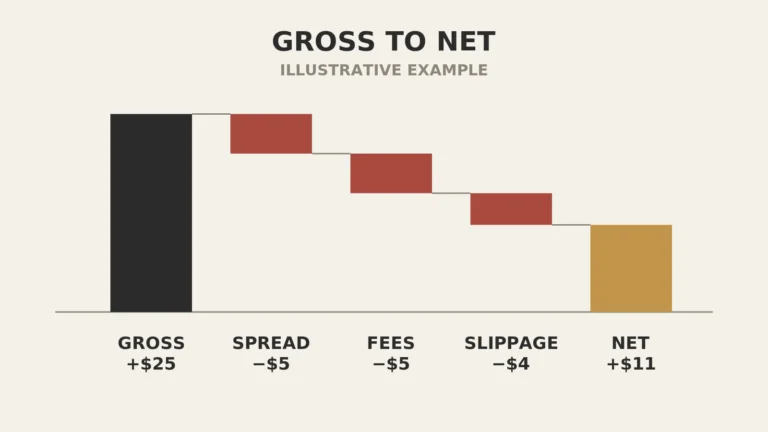
A complete perpetual trade record separates price profit and loss, realized funding debits or credits and execution fees or other applicable costs. For a hypothetical long trade, suppose fill-to-fill price P&L is +$30, realized funding is -$6 and trading fees total -$5. Net P&L is +$19. If funding were +$6 received instead, the result would be +$31 with the other figures unchanged.
These are accounting examples, not expected returns. Some trading platforms already include funding in realized or session P&L. If the report shows a net result including the transfer, do not subtract the funding ledger amount again. Reconcile the platform’s accounting definition first.
For high-turnover strategies, trading fees and execution slippage may dominate the cost of holding for a short period. For longer-held perpetual exposure, accumulated funding can become more relevant, particularly if the contract trades at a sustained premium or discount. The trading costs guide shows how to separate explicit charges from fill-price effects.
A strategy that treats the current rate as permanent can misprice its holding period. Instead, record realized rates, stress less favorable rates and check how net expectancy changes. If the edge disappears under a plausible funding scenario, the strategy’s assumptions need more scrutiny.
Can Receiving Funding Create a Reliable Carry Trade?
Some traders consider paired positions such as holding spot exposure and shorting an equivalent perpetual position when funding is positive. Under a simplified setup, a short perpetual could receive funding while the spot position offsets some directional price movement. This is often described as a cash-and-carry or delta-neutral funding approach.
The hedge is not risk-free. The spot and perpetual prices can diverge, sizing can drift, funding can change sign and the perpetual leg may face margin stress or liquidation. Transactions on both legs introduce spread, slippage and fees. A mismatch in custody, venue access or collateral can create additional risk.
Funding income is also not guaranteed. The position might receive one transfer, pay the next and require closing at an unfavorable basis. The economic result depends on the entire trade lifecycle, not a headline annualized funding number.
A realistic carry review estimates expected funding under several rate paths, spot-perpetual basis changes, hedge rebalancing costs and stressed collateral needs. Those checks establish exposure and break-even conditions. They do not turn a changing derivative transfer into a fixed yield.
How Should You Review Funding Before Holding a Position?
- Identify the exact product. Record the venue, symbol, contract type, settlement currency and whether funding is discrete or continuous.
- Check payment direction. Determine whether the displayed sign means your intended side pays or receives. Separate the current estimate from a final settlement value.
- Normalize the time interval. Note the funding timestamp or accrual basis. Compare rates over a common holding period rather than comparing unlike display periods.
- Calculate position notional. Apply the contract multiplier and relevant mark-price definition. Do not use posted margin in place of notional.
- Model more than one rate path. Test unchanged funding, a reversal of sign and a more adverse rate. Adjust notional if the strategy changes position size.
- Reconcile total trade costs. Include realized funding and applicable fees without counting amounts already reflected in the platform’s net P&L.
- Evaluate collateral and exits. Review margin impact, liquidation risk and liquidity available to close the position under adverse conditions.
The order book depth guide explains why a desired exit price may not be executable for the full size. Funding is one part of a holding decision. The ability to reduce or close risk when conditions change remains essential.
Common Funding Rate Mistakes
- Treating positive funding as a buy signal. A positive rate defines the paying side, not a forecast of price direction.
- Comparing different rate intervals directly. An hourly rate and an eight-hour equivalent require a common time basis.
- Applying the rate to margin. Funding commonly references contract position value under its specific rules.
- Assuming the displayed estimate is fixed. The rate may change before the relevant event or throughout continuous accrual.
- Calling received funding free yield. Price risk, basis changes, execution costs and liquidation exposure remain.
- Double-counting the transfer. Some P&L views already include funding in the reported result.
- Assuming one exchange’s formula applies everywhere. Contract specifications, caps and settlement methods differ.
Read Funding as a Cost and a Context Signal
Start with payment mechanics. Identify the product, settlement rule, final funding rate and relevant position value. Then calculate what your side would actually pay or receive. Only after that should you interpret the rate alongside price premium, open interest and market conditions.
Funding can influence the economics of a perpetual position without determining its outcome. A disciplined review treats it as a variable cash flow and a contextual indicator, never as a guaranteed return or a standalone trading signal.
Key takeaways
- Funding transfers pass between eligible long and short holders.
- The final rate and contract rules determine payment direction.
- Position notional usually determines the transfer amount, not margin.
- Funding can change across a holding period and across venues.
- Funding is market context rather than a price forecast.
Contract: Record venue, contract type and margin mode.
Timing: Identify funding events or continuous accrual.
Direction: Confirm which side pays at the final rate.
Notional: Calculate the eligible position value.
Scenarios: Estimate costs under several rate paths.
Reconcile: Compare realized transfers with net trade results.
Sources
- Bybit, Funding Fee Calculation, updated May 2026. Funding payment direction, linear and inverse contract calculations, settlement timing and margin effects.
- Bybit, Introduction to Funding Rate, updated May 2026. Premium index, interest component, rate limits and changing estimated rates.
- Coinbase Help, Funding Specifications: Global Derivatives. Continuous funding accrual, an eight-hour rate display and product-specific cash accounting.
- OKX, Revision of the Funding Rate Formula for Perpetual Futures, May 2026. Funding interval scaling and product-level methodology changes.
- Coinbase International Exchange, Trading Rules. Mark price, index price, position value and funding transfer definitions for its documented product.
- He, Manela, Ross and von Wachter, Fundamentals of Perpetual Futures, working paper, 2022, revised 2025. Funding incentives and the economic link between perpetual and spot prices.
Funding belongs in a documented plan for exposure, margin and execution costs. Nobilora Academy provides the foundations for evaluating derivative positions and market conditions.