Open Interest
Learn how Open Interest reveals market participation, conviction and trend strength.

Open Interest
- Use OI with price action
- Rising OI shows participation
- Falling OI shows position closure
- Always confirm with liquidity and structure
Open Interest helps traders understand participation in the futures market. It shows whether traders are opening new positions or closing existing ones.
OI does not predict direction. It helps measure conviction behind a move.
What Open Interest Means
Open Interest measures the total number of active futures contracts in the market.
Rising OI often signals growing participation and stronger market involvement.
Falling OI often suggests traders are closing positions or reducing exposure.
Price alone shows movement. OI helps explain participation behind the move.
How To Read Market Participation
Strong trends usually attract new participation.
- Rising price with rising OI often supports trend continuation
- Falling price with rising OI may signal growing bearish pressure
- Large moves with weak OI can lack conviction
- Flat or falling OI may signal exhaustion
Strong traders use OI to confirm momentum, not replace structure.
How To Use OI In Trading
- Check if participation supports the move
- Watch for rising OI near key liquidity zones
- Compare OI with market structure
- Look for confirmation before entering
Participation matters. Price without conviction can fail quickly.
Quick Recap
- OI measures participation
- Rising OI often supports stronger moves
- Falling OI may signal weaker conviction
- Always combine OI with structure and liquidity
- Open Interest measures participation, not prediction.
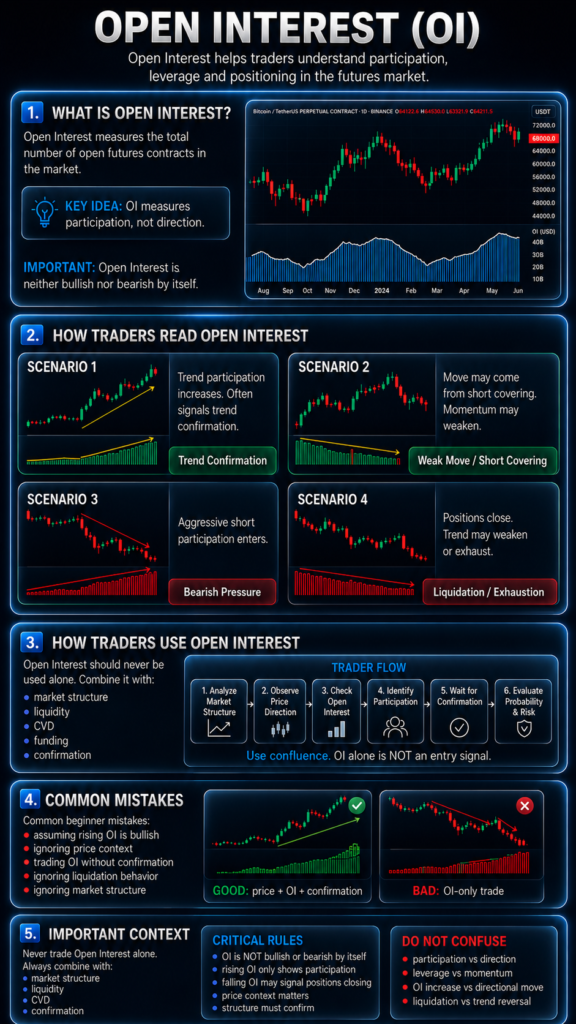
OI Logic:
Price ↑ + OI ↑ = Strong trend
Long Buildup = new long positions entering
Price ↑ + OI ↓ = Weak move
Short Covering = short positions closing
Price ↓ + OI ↑ = Strong bearish pressure
Short Buildup = new short positions entering
Price ↓ + OI ↓ = Positions closing
Long Unwinding / Liquidation = longs exiting the market
How to read it:
- Price + OI rising together = stronger conviction
- Price move without OI support = weaker momentum
- OI helps measure participation behind the move
The Fuel Gauge Rule:
Volume shows how much traded.
Open Interest shows whether new money stays in the market.
Rising OI often adds fuel to the trend.
If price breaks out while OI falls, momentum may weaken faster.
The Liquidation Trap:
A fast Price ↓ + OI ↓ move can signal aggressive long liquidations.
This chain reaction is often called a long squeeze.
Many traders wait for OI to stabilize before looking for reversals.
The Extreme OI Alert:
If OI reaches unusually high levels while price moves sideways, pressure may be building.
Large positioning battles can lead to strong breakout or liquidation moves.
Golden Rule:
Open Interest measures participation, not direction. Let market structure decide bias and use OI to judge conviction.