Learn how Open Interest reveals market participation, conviction and trend strength.

Open Interest
- Check contract type and exchange coverage
- Do not infer direction from OI alone
- Compare changes with price and volume
- Account for data limitations
Open Interest helps traders understand participation in the futures market. It shows whether traders are opening new positions or closing existing ones.
OI does not predict direction. It helps measure conviction behind a move.
What Open Interest Means
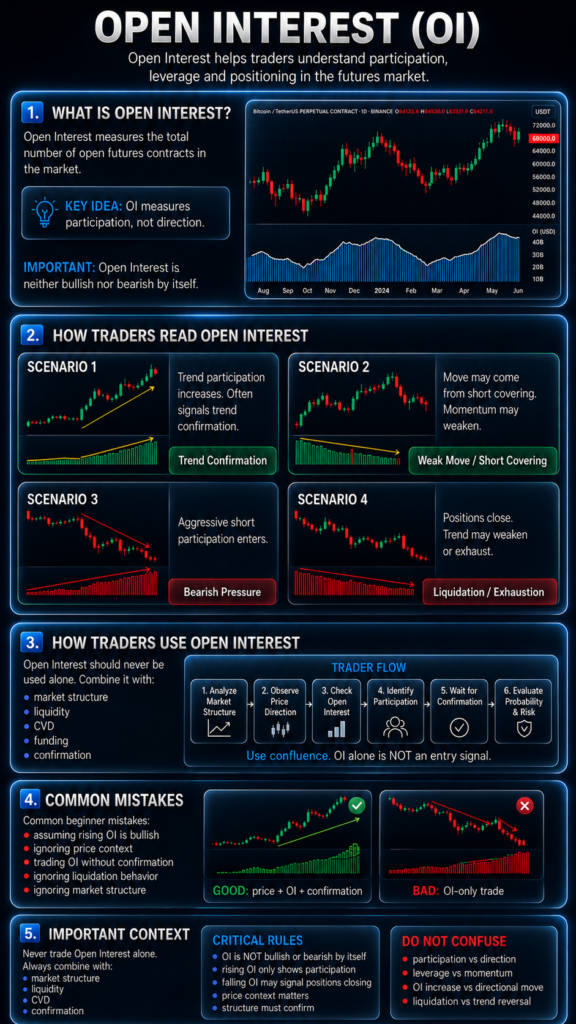
Open Interest measures the total number of active futures contracts in the market.
Rising OI indicates more outstanding contracts, with a long and a short side for each contract. It does not identify the winning direction.
Falling OI often suggests traders are closing positions or reducing exposure.
Price alone shows movement. OI helps explain participation behind the move.
How To Read Market Participation
Strong trends usually attract new participation.
- Rising price with rising OI shows price appreciation alongside more open contracts; continuation is not assured
- Falling price with rising OI shows more outstanding contracts during a decline, but not who will prevail
- Large moves with weak OI can lack conviction
- Flat or falling OI may signal exhaustion
Strong traders use OI to confirm momentum, not replace structure.
How To Use OI In Trading
- Check if participation supports the move
- Watch for rising OI near key liquidity zones
- Compare OI with market structure
- Look for confirmation before entering
Participation matters. Price without conviction can fail quickly.
Quick Recap
- OI measures participation
- Rising OI means more outstanding contracts, not proven trend strength
- Falling OI indicates fewer outstanding contracts, not measured conviction
- Always combine OI with structure and liquidity
Data and Interpretation Limits
Market indicators are descriptive measurements or conditional hypotheses. Data coverage, calculation settings and timeframe can change their interpretation. A pattern alone does not establish future price direction, participant motives or a profitable strategy. Define and test complete trading rules with realistic costs and risk limits.
End of lesson 3
Remember
- Open interest counts outstanding contracts with both long and short sides.
Open interest (OI): The number of outstanding derivative contracts at a stated time. Each contract has a long side and a short side. An increase indicates net creation of outstanding contracts, not a net directional position for the market.
Price up and OI up: Price rose as outstanding contracts increased. This does not prove long buildup or continuation.
Price up and OI down: Price rose as outstanding contracts decreased. This does not prove short covering.
Price down and OI up: Price fell as outstanding contracts increased. This does not prove short buildup.
Price down and OI down: Price fell as outstanding contracts decreased. This does not prove long liquidation.
Data limitations: Exchange coverage, contract specifications, reporting frequency and position transfers matter. OI does not measure capital inflow, conviction or trader identity.