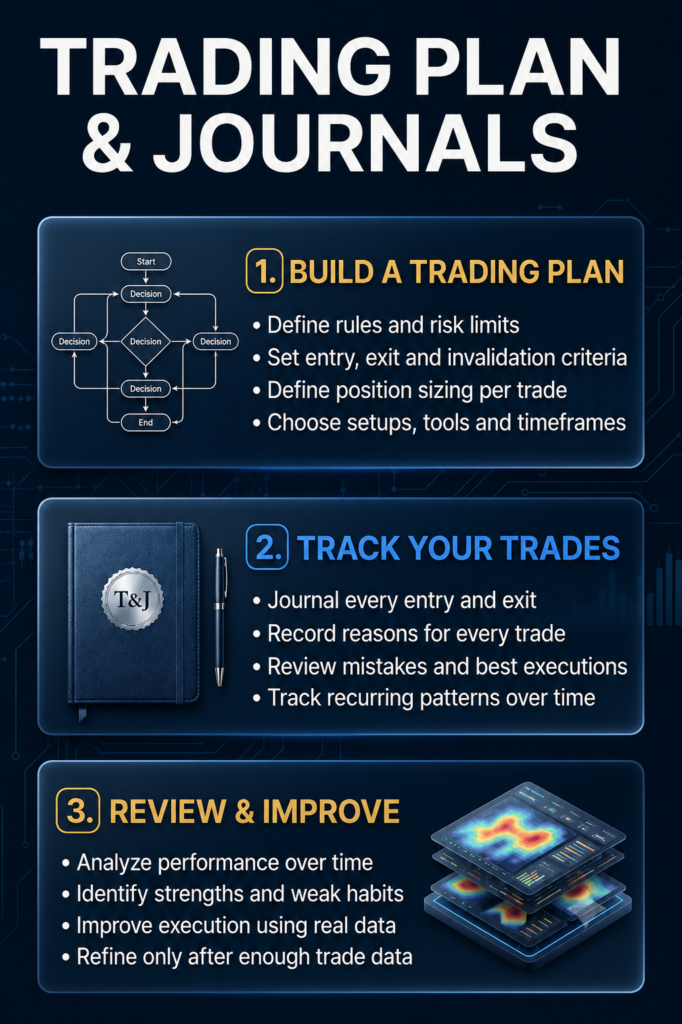
Build a structured trading system through planning, journaling and repeatable execution.

Trading Plans & Journals
- Define objective entry and exit rules
- Set an account-specific loss budget and position size
- Record all trades and execution costs
- Review both successful and unsuccessful trades
- Evaluate strategy expectancy on adequate data
Why Trading Systems Matter
Trading losses can arise from negative strategy expectancy, costs, leverage, execution mistakes and inconsistent decisions.
A trading plan gives structure. A journal creates feedback. Together they can make decisions easier to document and review. They do not remove market uncertainty.
Without a system, every trade feels different. With a system, decisions become clear.
What Every Trading Plan Must Include
- Entry conditions: define observable conditions, timing and invalidation. A BOS or OB label alone does not establish an edge.
- Exit strategy: define take-profit zones before entering the trade.
- Stop loss placement: place stops at technical invalidation, not emotional comfort.
- Risk management: calculate size from a defined loss budget, stop distance, execution costs and instrument mechanics.
A trading plan is a checklist, not a suggestion.
Why Journaling Changes Results
Your journal reveals what emotions hide.
- What setup you traded
- Why you entered
- Why you exited
- What emotion was present
- What rule you followed or broke
- What should be repeated or removed
Strong traders improve through awareness and repetition.
Quick Recovery System
- Review your journal weekly
- Identify one repeating mistake
- Remove that mistake for seven days
- Test one promising process improvement
- Repeat the process every week
Consistency comes from following the same process repeatedly.
Quick Recap
- Trading plans reduce emotional decisions
- Journaling reveals blind spots
- Entries require confirmation
- Exits should be pre-planned
- Consistency comes from repetition
Evidence and Practical Limitations
These concepts are educational frameworks, not verified predictions or guarantees of profit. Test precise rules on independent data and include fees, spreads, slippage, leverage and the possibility of losses beyond a planned stop. Record both successful and unsuccessful outcomes to avoid hindsight bias.
End of lesson 6
Remember
- A trading plan creates structure. A journal creates progress.