Find the trading style that matches your personality, time availability and emotional tolerance.

- Compare time demands and trading costs
- Consider overnight and leverage risks
- Test execution in realistic conditions
- Choose a sustainable process
Why Trading Style Matters
Your trading style should match your personality, time availability and emotional tolerance.
The wrong style creates stress. The right style creates clarity.
Three common trading styles are scalping, day trading and swing trading. Other approaches also exist.
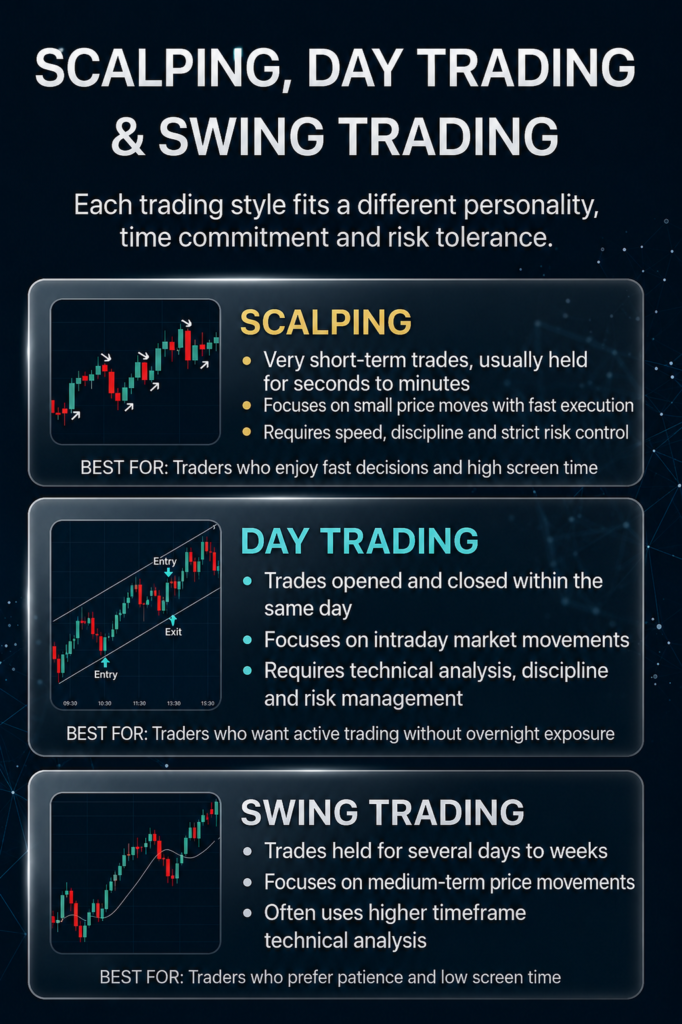
Scalping
Scalping is fast and intense.
- Trades last seconds to minutes
- Requires fast decisions and strong focus
- May offer more price movement, but volatility also increases execution risk
- Uses small targets and tight stop losses
- Emotionally demanding
- Best for traders who enjoy speed and precision
Scalpers need discipline. Hesitation destroys execution.
Day Trading
Day traders open and close positions within the same day.
- Clear daily routine
- Balance between volatility and screen time
- Requires discipline with less pressure than scalping
- Requires adequate time, liquidity and attention during the chosen session
Day traders rely on structure, confirmations and timing.
Swing Trading
Swing traders hold positions for days or weeks.
- Lower screen time and more planning
- Potentially fewer intraday decisions, but overnight gaps and holding risk remain
- Focus on higher timeframe structure
- Requires patience during pullbacks
Swing traders let the market breathe.
How To Choose Between Trading Styles
Choose the style that fits your personality and routine.
- Scalping for fast conditions and active traders
- Day trading for structured daily execution
- Swing trading for calm and planned decision-making
Choose a style using testable rules, time availability, transaction costs and acceptable risk. Build your system around it.
Quick Recap
- Choose a style that fits your personality
- Scalping is fast and intense
- Day trading is structured and active
- Swing trading is patient and strategic
- Consistency matters more than speed
Evidence and Practical Limitations
These concepts are educational frameworks, not verified predictions or guarantees of profit. Test precise rules on independent data and include fees, spreads, slippage, leverage and the possibility of losses beyond a planned stop. Record both successful and unsuccessful outcomes to avoid hindsight bias.
End of lesson 5
Remember
- Choose a trading style based on time, risk, costs and tested rules.