
Outcome bias can make lucky wins look smart and justified losses look foolish. Learn how to assess decisions without ignoring evidence from results.

Outcome Bias in Trading: Judging Decisions Beyond P&L
- Name the decision being evaluated.
- Recover the information available at the time.
- Check both reasoning and documented rule compliance.
- Imagine the same decision producing another outcome.
- Identify evidence that would justify a revised assessment.
Trading Journal Review provides the practical classification workflow. This article examines the cognitive bias behind inconsistent judgments and the distinction between compliance, justification and strategy evidence.
A trader breaks a position-size rule and finishes with a profit. Another trader follows a well-documented plan and finishes with a loss. It is tempting to praise the first trade and criticize the second. Yet the outcome alone tells us little about whether either choice made sense when it was made.
Outcome bias in trading means judging an earlier trading decision by its profit or loss rather than the evidence, choices and constraints available when the decision was made. A favorable outcome can disguise a rule violation. An unfavorable outcome can make a reasonable choice look careless.
A good review asks three different questions. Was the decision justified? Did the trader follow the written rules? What do recorded results tell us about the strategy? Separating these questions helps beginners learn from trades without mistaking luck for skill.
What Is Outcome Bias in Trading?
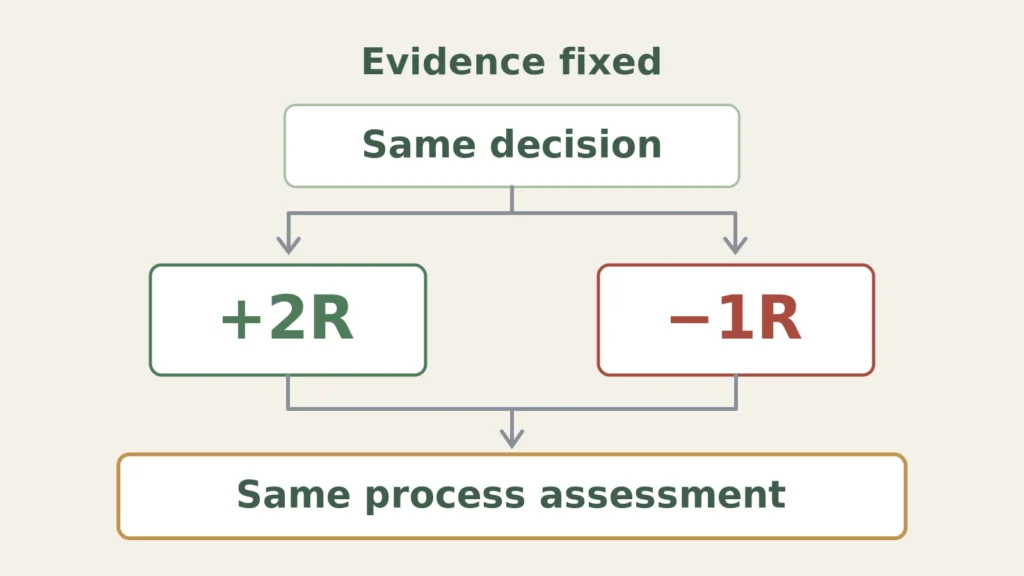
Outcome bias occurs when the same decision receives a different quality assessment because its outcome was favorable or unfavorable. The relevant comparison holds the decision and the information available at the time fixed. Only what happened afterward changes. This is the pattern tested in Aiyer and colleagues’ 2023 replication study.
Suppose you judge an entry as reckless after a loss. Ask what made it reckless before the loss occurred. Excessive position risk, an unmet entry condition or an unsupported assumption would be reasons. “It lost money” describes the outcome, not the earlier defect.
The reverse matters too. A profitable trade can contain the same defect. If a risk violation becomes acceptable only because the position recovered, the evaluation depends on information that was unavailable when the risk was taken.
This does not mean every losing trade was reasonable. It means the criticism needs a reason that survives a change in the outcome.
What Does the Research Actually Show?
In five experiments published in 1988, Jonathan Baron and John Hershey found that people gave more favorable ratings to decisions with good outcomes. Their scenarios involved medical choices and monetary gambles. Participants were told the relevant information available to the decision maker, yet the result still influenced their assessments.
Aiyer and colleagues replicated part of that research in 2023 using 692 online participants. People evaluated the quality of a medical decision more favorably when its outcome succeeded than when it failed. The researchers tested judgment in a controlled scenario, not real trading orders.
These findings matter for trading education because traders also make decisions with uncertain outcomes. They do not measure how often professional traders experience outcome bias or show that a particular trading checklist increases returns.
A closer financial setting appears in research by König-Kersting, Pollmann, Potters and Trautmann. Across three experiments, clients’ evaluations of financial agents were affected by random investment outcomes, even when the investment decision was known. In one experiment, an unfavorable result following the requested investment received a worse satisfaction rating than a favorable result that departed from the request. The paper appeared online in September 2020 and in the 2021 volume of Theory and Decision.
The financial-agent experiments test evaluations of another person, not self-review by active traders. Their main lesson is about how an outcome can distort the standard used to judge a decision. They do not establish that the exercise below removes the bias.
Related research by Arvid Hoffmann and Thomas Post linked individual investors’ recent returns with their belief in their own investment skill. The 2014 study addresses self-attribution rather than outcome bias itself. It helps explain why recent gains can feel like proof of personal ability when they may also reflect uncertainty and market conditions.
Separate Three Questions About a Trade
Was the Decision Justified at the Time?
Evaluate the information, alternatives and constraints that existed when the choice was made. What supported the setup? What would invalidate it? Were expected costs and downside risks acceptable under the stated approach? Was not trading a reasonable alternative?
This is an assessment of reasoning under uncertainty. It does not require pretending you knew an exact win probability. If that probability was uncertain, the uncertainty belongs in the assessment.
Did Execution Follow the Documented Rules?
Compliance is narrower. A trader can follow a poorly supported plan precisely. Another can depart from a sound plan and make money. Neither result merges the quality of the plan with adherence to it.
For example, opening a position before a required confirmation is an execution deviation if that requirement was documented. Whether the confirmation rule itself deserves to remain is a separate strategy question. A favorable outcome cannot answer both.
The trading journal review guide provides the operational method for recording compliance and uncertain records. The point here is why the evaluation standard must not change with the result.
Does the Strategy Have Adequate Evidence?
A strategy assessment concerns results across relevant observations, execution conditions and costs. It is not settled by one apparently well-reasoned entry. “I followed the plan” is evidence about adherence, not proof of positive expectancy.
The trading expectancy guide explains how payoff sizes and win frequency combine. Keep that performance question open even when you conclude that a particular decision followed the rules.
A later loss can reveal a weak execution assumption or a strategy that needs reevaluation. It cannot change the information that was available when the earlier decision occurred. Keep the historical record intact and revise future decisions when credible new evidence warrants it.
A Controlled Example: Change the Outcome, Not the Decision
Consider two alternative versions of one hypothetical trade. In both versions, the trader sees the same information, applies the same documented entry conditions and uses the same position size. Planned initial monetary risk is $100, so 1R equals $100.
In version A, the position closes for a net gain of $200, or +2R. In version B, it closes for a net loss of $100, or -1R. These are illustrative alternative outcomes, not two observed trades. The net amounts already include trading costs.
| Review question | Gain outcome | Loss outcome |
|---|---|---|
| Entry information | Same evidence | Same evidence |
| Documented action | Same compliant decision | Same compliant decision |
| Net result | +$200 (+2R) | -$100 (-1R) |
| Entry-time assessment | Unchanged | Unchanged |
Before the result is known, suppose the available record supports the statement: “The entry met the documented requirements, but the strategy’s expected value remains uncertain.” That statement remains true in both versions. The gain does not establish the edge. The loss does not retroactively remove the evidence supporting the entry.
Now change a different fact. Suppose the trader used $300 of planned initial risk despite a $100 limit. That is a documented risk violation even if the trade wins. You have changed the decision, not merely its outcome, so the process assessment should change.
Keep the comparison precise. Holding the earlier choice fixed does not mean ignoring newly discovered information about that choice. A later audit might reveal that a required signal had not occurred. That evidence can justify revising the assessment. The sign of P&L alone cannot identify the defect.
The Outcome-Flip Test: Would You Judge It Differently?
The Outcome-Flip Test is a Nobilora teaching exercise. It keeps the earlier decision fixed and imagines a different result. Its purpose is to reveal an inconsistent judgment, not to validate the trading strategy or promise better performance.
- Name the decision: isolate the choice being judged, such as entry timing, position size or an exit instruction. Do not evaluate an entire trading career from one result.
- Freeze the information set: list the evidence available at that moment. Leave out later price action and explanations discovered afterward.
- Write the assessment: state what was justified, what violated a requirement and what cannot be determined. Give a reason for each conclusion.
- Swap only the result: imagine the identical earlier decision ending with the opposite financial outcome. Ask whether your assessment changes and why.
- Identify the missing evidence: specify what would justify a different conclusion, such as an overlooked constraint or independent evidence about the strategy.
If your reason changes from “sensible risk” to “obvious recklessness” when only the outcome changes, investigate that inconsistency. Do not replace it with automatic praise for every compliant trade. The appropriate answer may be that the decision was insufficiently documented or the strategy justification remains weak.
Outcome Bias and Hindsight Bias Ask Different Questions
Use a practical distinction. Outcome bias concerns how good you think the earlier decision was. Hindsight bias concerns how predictable you now think the event was. One evaluates the choice. The other rewrites your view of what could have been known.
After a breakout fails, “The entry was foolish because it lost” is an outcome-based evaluation. “The reversal was obvious all along” is a claim about earlier predictability. A trader can make either error or both.
The correction must address the actual claim. For the decision assessment, ask whether your reasoning survives the opposite outcome. For the predictability claim, compare it with timestamped expectations rather than a chart viewed after the move.
Baruch Fischhoff’s research on hindsight bias found that knowing what happened can make the result appear more predictable in retrospect. A dated pre-trade forecast is useful here because it records what the trader actually expected before the market moved.
For the broader foundation, the Academy lesson on trading psychology places decision habits alongside strategy quality and execution costs. This article narrows the focus to the standard used to judge a choice.
What Can a Result Change?
A completed trade adds information, but not every new fact changes the same judgment.
| New observation | Appropriate response |
|---|---|
| A rule-breaking trade makes money | Record the gain and keep the rule violation marked |
| A planned stop fills worse than assumed | Review execution assumptions and future risk limits |
| Many comparable trades underperform | Reevaluate strategy evidence and market conditions |
Key distinction: Update your model when evidence changes. Do not rewrite the earlier decision simply because its result was favorable or unfavorable.
Can a Good Strategy Lose Money in a Short Sample?
Yes. A short run can end badly even when a strategy has a positive expected result. Consider a purely hypothetical model with independent trades, a 50% win probability, a net +1.5R for every winner and -1R for every loser. Its expected result is +0.25R per trade.
Across ten trades, the model loses money when it wins three or fewer. The exact binomial probability is about 17.19%. This is a property of the stated mathematical assumptions, not a measured market win rate or proof that a real strategy works.
One bad streak does not prove the rules were wrong. It also does not prove that the strategy retains its edge. Actual outcomes, costs and market conditions must still be investigated over a relevant sample. The trading expectancy guide explains that sample-level question in more detail.
Do Not Turn Process Thinking Into an Excuse
“Focus on process” becomes unhelpful when it prevents any conclusion from changing. A reasonable decision can lose. A sequence of losses can also expose a false assumption, unsuitable execution conditions or a strategy that no longer behaves as expected.
Use results to investigate those possibilities. Keep every realized gain and loss in the account record. Compare relevant observations with the assumptions documented before the review. Distinguish a concern about execution from a concern about the trading model.
There is no universal trade count that establishes an edge. Outcomes can share market exposures, costs can change and estimates can be imprecise. The backtesting guide explains why a rule that fits the observations used to design it still needs independent evaluation.
A useful question is: “What evidence would lead me to reduce risk, pause this approach or reject this assumption?” If the answer is “nothing, because the process was correct,” the process claim has become impossible to challenge.
Change Rules for Reasons You Can Test
Imagine a trader doubles the allowed position size and profits. The result may motivate a hypothesis about sizing, but it does not validate the larger exposure. Risk capacity, drawdown tolerance and the distribution of possible losses still matter.
The same standard applies after a loss. Moving a stop farther away because price later recovered may improve that historical example while increasing losses elsewhere. The later recovery is not, by itself, a justification for the rule.
Write the proposed change as a testable claim. Explain which assumption it addresses, which risk constraints remain fixed and what independent observations would count against it. A rule change should face unfavorable examples as well as the event that inspired it.
Judge the Choice Without Erasing the Result
Choose one recent decision and state your assessment without using profit or loss as the reason. Then swap the outcome while holding the earlier evidence and action fixed. If the judgment changes, identify the fact that supposedly justifies the change.
Keep both records intact: what was defensible at the time and what actually happened. Decision quality, execution adherence and strategy performance belong together in a review, but they are not interchangeable verdicts.
Key takeaways
- A favorable outcome cannot erase a known risk violation.
- A compliant trade does not prove a strategy has positive expectancy.
- Decision quality requires the information available when choosing.
- Hindsight and outcome bias distort different judgments.
- Results remain necessary evidence for evaluating strategy performance.
Freeze: Write the original decision and available evidence.
Assess: Judge justification and rule adherence separately.
Flip: Imagine another outcome with the decision unchanged.
Compare: Note whether the decision rating changes.
Investigate: Specify new facts that would justify a different rating.
Update: Use broader net results to test the strategy.
Sources
- Baron and Hershey, Outcome Bias in Decision Evaluation, Journal of Personality and Social Psychology, 1988. Five experimental studies of outcome-dependent decision ratings.
- König-Kersting, Pollmann, Potters and Trautmann, Good Decision vs. Good Results, Theory and Decision, 2021. Three experiments evaluating risky financial decisions by agents.
- Aiyer and colleagues, Outcomes Affect Evaluations of Decision Quality, International Review of Social Psychology, 2023. Preregistered replication involving medical decision scenarios.
- Fischhoff, Hindsight Is Not Equal to Foresight, 1975, reprinted in Quality and Safety in Health Care, 2003. Experimental findings on retrospective predictability judgments.
- Hoffmann and Post, Self-Attribution Bias in Consumer Financial Decision-Making, Journal of Behavioral and Experimental Economics, 2014. Association between individual investment returns and perceived skill.
Fair evaluation starts with a record of your rules and reasoning. The Nobilora Academy explains how trading plans and journals preserve those details for later review.