
Learn to use an economic calendar for crypto trading. Read CPI, jobs and Fed events, compare actual data with forecasts and prepare for event risk.

Economic Calendar for Crypto Traders: Understanding Event Risk
- Verify the official release time and timezone.
- Record the forecast and its source.
- Check open exposure and margin constraints.
- Review order behavior before the event.
- Read actual results and revisions at the source.
- Record execution conditions after publication.
The Economy Academy lesson introduces the macroeconomic background. This guide focuses on the operational process of checking event risk around active crypto positions.
An economic report can arrive at a known time and still catch a crypto trader unprepared. The calendar tells you when new information is due. It cannot tell you the number in advance or how Bitcoin will react.
An economic calendar for crypto traders is a practical tool for identifying scheduled releases, comparing reported figures with expectations and reviewing open positions ahead of a possible change in market conditions. It is not a trading signal.
In this guide, you will learn how to read one calendar entry, follow major U.S. announcements, handle timezones and revisions and apply a repeatable event-risk check without guessing market direction.
What Does an Economic Calendar Actually Tell You?
An economic calendar lists upcoming reports and policy announcements. A typical entry shows an event name, publisher, scheduled time, reference period and, once data are available, a result. Many commercial calendars also display an expected value and a rating of the event’s importance.
The key distinction is between known scheduling and unknown outcomes. A release time may be published weeks in advance. The actual result and the market’s response remain uncertain. A surprising number can affect expectations for interest rates or economic growth. It does not mechanically determine crypto prices.
Official calendars help with timing. The U.S. Bureau of Labor Statistics (BLS) publishes schedules for inflation and employment reports. The Federal Reserve lists monetary policy meetings. The Bureau of Economic Analysis (BEA) maintains a separate schedule for GDP and other economic estimates. Check the original publisher when a calendar entry matters to an open position.
For the background on inflation, economic growth and monetary policy, see the Economy Academy lesson. This article focuses on using scheduled information in a trading-risk review.
How Do You Read One Calendar Entry?
Begin with the event and its exact publication time. Then read the forecast, actual and previous values. These numbers serve different purposes and may come from different sources.
| Field | Meaning | Check before comparing |
|---|---|---|
| Event and time | Report and scheduled publication | Publisher, date and timezone |
| Reference period | Month or quarter being measured | Same period and measurement basis |
| Previous | Earlier published result | Whether it was later revised |
| Forecast | Estimate collected before the report | Provider, timestamp and unit |
| Actual | New reported result | Official number and unit |
A forecast is generally an estimate collected by a calendar or data provider. It does not necessarily come from the government agency issuing the report. Two calendars can show different forecasts. Save the number and its source when you make your pre-release review.
A provider’s high-impact icon is also an interpretation. It does not specify the probability, size or direction of a crypto price move. If a number looks unusual, go to the publisher’s release and check the full context.
Which Releases Should a Beginner Watch?
Start with a short list. There is little value in following every calendar entry without knowing what it measures. Inflation, employment and central bank decisions are useful starting points. Their influence on trading conditions can change over time.
Consumer Price Index (CPI)
The Consumer Price Index measures changes in prices paid by consumers for a basket of goods and services. The BLS publishes both monthly and 12-month percentage changes. Calendars may distinguish headline CPI from measures excluding food and energy, often called core CPI.
A monthly change of 0.2% and a 12-month change of 3.2% refer to different periods. They cannot be compared as if they were the same series. Seasonally adjusted and unadjusted measures can also differ. Check the metric before deciding that a reported value beat or missed a forecast. The official BLS CPI documentation explains the measures.
Employment Situation and payrolls
The BLS Employment Situation report includes nonfarm payroll employment and the unemployment rate. Payroll estimates mainly come from an establishment survey. The unemployment rate comes from a household survey. They are separate measurements, not two labels for the same number.
The first payroll estimate can change as new information arrives. BLS routinely revises recent monthly estimates, so a report can contain both a new number and changes to earlier months. A trader who reads only the headline can miss part of the information. See the BLS Employment Situation technical note.
Federal Reserve decisions
The Federal Open Market Committee (FOMC) makes U.S. monetary policy decisions, including decisions on the target range for the federal funds rate. Its meeting calendar is published by the Federal Reserve. Statements, economic projections and press conferences can convey different information about policy expectations.
A decision that matches expectations can still be followed by a market reaction as participants interpret the statement or later comments. FOMC minutes are released separately and belong on the calendar as their own event. Confirm the specific schedule in the Federal Reserve meeting calendar.
Growth data and other central banks
The BEA publishes gross domestic product estimates and personal income data. GDP measures economic output, and its estimates can be updated as additional source data become available. The BEA release schedule identifies publication dates.
Traders may also monitor policy meetings of the European Central Bank. Its announcements have their own schedule and timezone. The objective is not to monitor every central bank. It is to recognize which official announcements are relevant to the assets and exposures you already follow.
The difference between actual and forecast is a measurement of expectations, not a prediction of Bitcoin prices. A useful review separates the published information, current exposure and actual execution conditions. Document those observations independently instead of treating one number as the whole explanation.
What Is the Difference Between Forecast, Actual and Surprise?
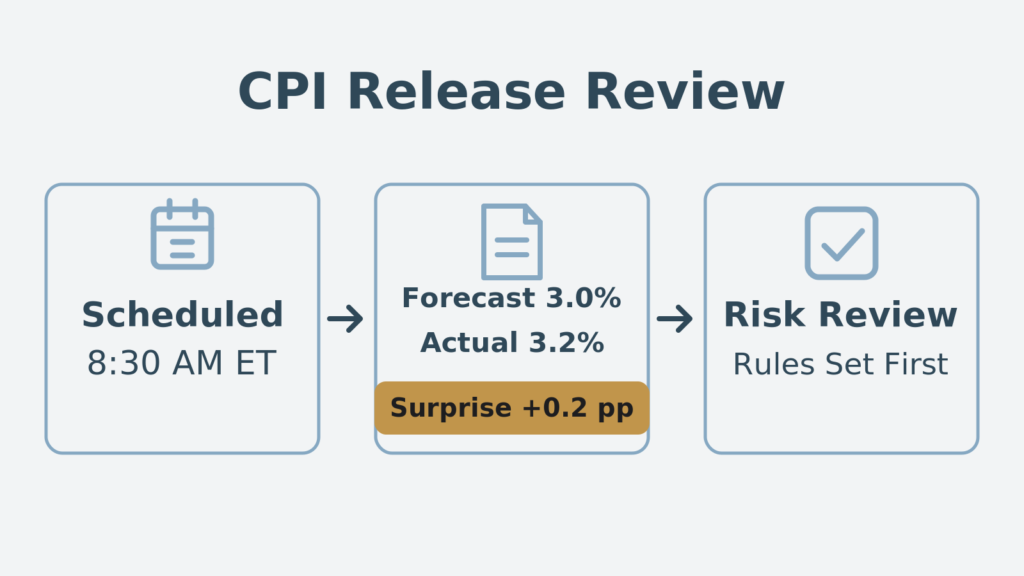
Consider a fully illustrative CPI release. Suppose a calendar lists an expected 12-month inflation rate of 3.0%. The newly published rate is 3.2%. Assume both figures describe the same CPI measure and reference period.
The actual result is 0.2 percentage points above forecast. That difference is the economic surprise. It is not a 0.2% return, a predicted change in Bitcoin’s price or proof that a trade should be opened.
If the previous comparable rate was 3.1%, the actual number is also 0.1 percentage points above the previous reading. These are two different comparisons. The surprise compares the actual result with a pre-release expectation. The change from the previous report compares two observations.
For a real analysis, write down the specific series, forecast provider and time you captured the estimate. A forecast observed after the release is not a reliable record of what you knew beforehand. These example figures are invented for teaching, not historical CPI data.
Why Do Revisions Matter?
An earlier reported figure is not always final. Revisions occur when an agency receives more complete data or updates its methods. The latest number can tell one story, and changes to prior observations can alter how it should be interpreted.
Payroll figures are a clear example. Preliminary estimates for recent months are normally revised in later Employment Situation reports. GDP estimates also appear in stages as the BEA incorporates additional information. CPI revision rules differ by series. BLS says unadjusted CPI indexes are final when issued, but seasonally adjusted indexes can be revised as seasonal factors change.
During a release review, record the previously displayed value and check whether it has changed. Do not mix an old forecast with a revised series or compare a monthly reading with a 12-month rate. A calendar provider may display only part of the revision information, so the official release remains the reference.
How Do You Handle Release Times Across Timezones?
Many BLS releases, including CPI and Employment Situation, are commonly scheduled for 8:30 a.m. Eastern Time. The BLS explicitly labels its release calendar in Eastern Time. Verify the specific event because schedules can change.
Eastern Time switches between standard time and daylight saving time. European countries do not always change clocks on the same dates as the United States. For several weeks each spring and autumn, a fixed conversion can be one hour wrong.
Set your calendar to your actual local timezone. Compare the displayed time with the publisher’s schedule. When an event matters to open positions, record both the original release time and your local equivalent. A saved screenshot from an earlier month may contain an outdated conversion.
For crypto traders, the timing problem is operational. Digital assets may trade throughout the day, so a major release can occur outside your normal review hours. Decide how you will handle that event rather than assuming you will be available when it happens.
What Can Change Around a Scheduled Release?
New information can cause market participants to update bids, offers and positions. During active periods, the spread between the best available buying and selling prices may widen. Available order-book depth can change, and a trade can fill at a different price from the one visible a moment earlier.
None of this is guaranteed during a particular CPI or FOMC event. It is a risk to consider, not a directional forecast. A stop order can help structure a plan, but a stop-market order does not guarantee its eventual fill price. A stop-limit order may not fill at all.
Review the mechanics in market, limit and stop orders and the practical effects of spreads, fees and slippage. Both matter when an event changes the conditions in which an order is executed.
A positive or negative surprise also does not tell you how an asset must trade. The response can depend on broader economic expectations, positioning, liquidity and other information. The market regime analysis framework gives a wider context for interpreting changing conditions.
One CPI Release, Three Separate Questions
Illustrative 12-month CPI figures. The comparison is valid only when both values use the same series and reference period.
| Question | Example | Interpretation |
|---|---|---|
| When is the report due? | 8:30 a.m. ET | Verify the official schedule and local time |
| What differed from expectation? | Actual 3.2%, forecast 3.0% | Surprise of +0.2 percentage points |
| What should the trader review? | Open exposure and order behavior | Risk check, not an automatic buy or sell signal |
The figures are hypothetical, not historical CPI data. Even a correctly measured surprise does not determine the direction of crypto prices.
How Do You Build an Event-Risk Review Before the Release?
The strongest use of a calendar is a decision process completed before the actual number appears. You are checking exposure and execution conditions, not predicting the release.
- Confirm the event. Identify its official publisher, reference period, release date and local time.
- Record expectations. Save the forecast, provider and timestamp. Confirm that the units match the upcoming report.
- Review open exposure. Write down current positions, size, leverage and any margin constraints. The position sizing guide explains how trade size relates to planned loss.
- Check order behavior. Know whether your exit order prioritizes execution or a price boundary. Consider the possibility of slippage or no fill.
- Decide your response in advance. Follow your documented rules for holding, reducing or avoiding new exposure. A calendar alone cannot choose for you.
- Set the follow-up review. Decide when you will compare the published result with your recorded expectations and inspect actual fills.
Leverage deserves special attention. A rapid unfavorable price change can reduce available margin, and an exchange may liquidate a position under its contract rules. Read the margin and liquidation guide for the distinction between maintenance requirements and voluntary exits.
Having no open positions is also a valid starting point for a calendar review. You can observe how the market responds and document what happened without placing a trade.
What Should You Check After the Report?
Start with the official release, not the first social post about it. Confirm the series, reporting period and units. Compare the actual value against the expectation you saved before publication. Read any revised prior numbers or accompanying comments.
Only then assess trading conditions. If you held a position, record the spread, order trigger, actual execution price and costs that you can verify. Separate three observations in your journal: what the agency reported, what the market did and what your trade actually received.
Those observations are related but not identical. A positive surprise does not establish that it caused every price movement. A correct expectation does not prove that your execution was good. The value of the review comes from keeping these questions separate.
Common Mistakes With Economic Calendars
- Using a fixed timezone conversion. Daylight saving changes can move a release by one hour in your local schedule.
- Treating the forecast as official data. The estimate may come from a third-party survey or calendar provider.
- Comparing different metrics. Monthly, annual, headline and core readings are not interchangeable.
- Ignoring revisions. Employment and GDP reports may change earlier estimates.
- Using an impact icon as a trading rule. It does not guarantee volatility or market direction.
- Confusing a surprise with a signal. The data difference alone cannot tell you to buy or sell.
- Overlooking execution risk. Knowing the event time cannot guarantee a particular fill or protect against liquidation.
Frequently Asked Questions
Is an economic calendar useful if I do not trade the news?
Yes. It can help you identify scheduled uncertainty around positions you already hold. You can use it for exposure reviews, alerts and post-release observation without entering a news trade.
Does higher-than-forecast CPI always make Bitcoin fall?
No. It may affect rate expectations, but crypto’s response depends on the wider market setting and what participants had already expected. The surprise alone is not a directional rule.
Which timezone should I use?
Use the timezone in which you actually plan and monitor positions, then compare the converted time against the official publisher’s schedule. Recheck it around daylight saving transitions.
Make the Calendar Part of Your Risk Routine
An economic calendar is most useful when it changes how you prepare, not when it encourages a prediction. Identify the official release, verify its time, record the expectation and review the exposure already on your books.
After publication, compare like with like and document both the information and your actual trading conditions. Begin with CPI, the Employment Situation and FOMC meetings. Add other events when they genuinely matter to your process.
Key takeaways
- A calendar identifies scheduled information, not future market direction.
- Official results and third-party forecasts come from different sources.
- A surprise measures an expectation gap, not a trading signal.
- Revisions and units change how data should be interpreted.
- Execution risk remains when a release time is known.
Schedule: Confirm event, reference period and local time.
Expectations: Save forecast source and timestamp.
Exposure: Review size, leverage and stop order behavior.
Decision: Document your pre-release risk rules.
Report: Compare like-for-like actual and forecast values.
Follow-up: Record revisions, spreads and actual execution.
Sources
- U.S. Bureau of Labor Statistics, Schedule of News Releases. Official timing, reference periods and Eastern Time convention.
- U.S. Bureau of Labor Statistics, Consumer Price Index and Using Seasonally Adjusted Data. CPI definitions and revision considerations.
- U.S. Bureau of Labor Statistics, Employment Situation Technical Note. Payroll estimates and recent-month revisions.
- Board of Governors of the Federal Reserve System, FOMC Meeting Calendars. Monetary policy meeting schedules and releases.
- U.S. Bureau of Economic Analysis, Release Schedule. GDP and personal income announcement timing.
- European Central Bank, Monetary Policy Meeting Calendar. Additional central bank announcement schedules.
Event awareness is only one part of a risk process. Nobilora Free Lessons explain the wider foundations of position management and market mechanics.