Spot and perpetual futures can track similar prices but differ in asset ownership, margin, funding and liquidation. Learn the distinction with clear examples.

Spot vs. Perpetual Futures: Understanding the Differences
- Identify the product before entering.
- Check what the executed trade creates.
- Compare notional exposure with collateral.
- Review funding and maintenance margin rules.
- Read custody, settlement and exit conditions.
This foundational article follows the published guide to order types and prepares readers for margin and liquidation mechanics. The funding rates article covers recurring contract payments in detail.
A spot crypto balance and a perpetual futures position can respond to the same market, but they do not represent the same product. One is an asset you purchased. The other is a contract whose value depends on price movement.
For beginners, the most useful spot vs perpetual futures distinction is not the chart or the trading interface. It is what appears in your account after the trade and what obligations remain open.
This guide explains each instrument, compares a fair $1,000 price exposure and then shows what changes when leverage increases the position size. The examples are hypothetical and exclude fees unless noted.
Spot vs. Perpetual Futures: What Does Each Trade Create?
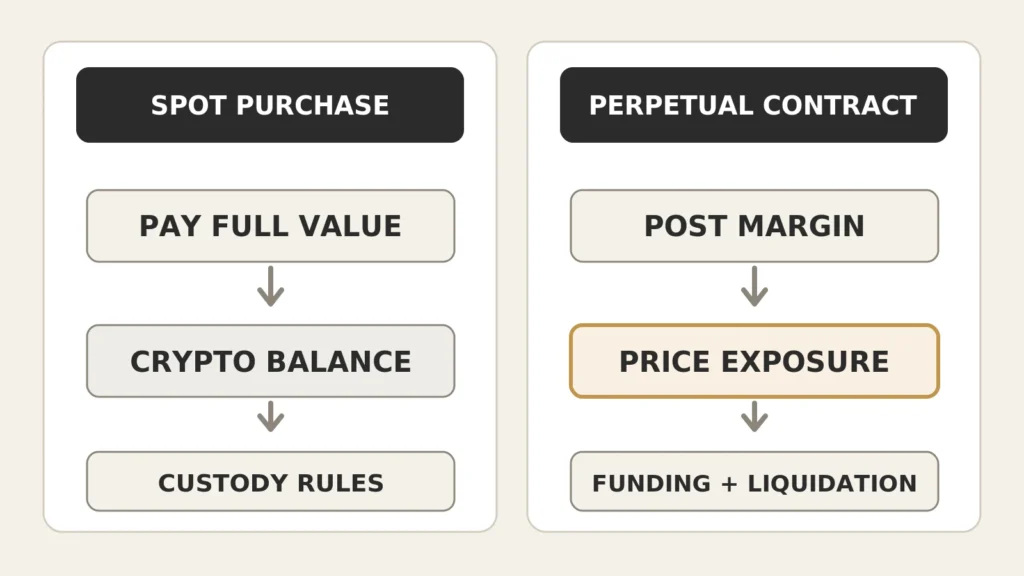
In an ordinary spot purchase, you exchange money or another asset for a cryptocurrency. Once the trade settles, your account records a balance of the purchased coin. You can hold or sell that balance and may be able to transfer it to an eligible wallet under the platform’s rules.
A perpetual future is a derivative contract linked to an underlying market. A long position gains from rising contract prices and loses from falling prices. A short position has the opposite price exposure. Opening the contract does not itself place the underlying cryptocurrency in your spot wallet.
| Feature | Fully funded spot | Standard perpetual future |
|---|---|---|
| What appears in the account? | Purchased crypto balance | Open derivative position |
| What supports the position? | Full purchase payment | Posted collateral and margin rules |
| Can a margin engine close it? | Not in an unborrowed spot purchase | Yes, if margin requirements are breached |
| Does perpetual funding apply? | No | Under the contract’s funding rules |
| Can it be opened short? | Not through an ordinary purchase | Typically yes |
| Fixed contract expiration? | No contract to expire | No fixed expiry in standard perpetuals |
This comparison excludes borrowed spot trading, special derivatives and exchange-specific exceptions. Those products need their own terms checked.
Does Buying Spot Mean You Control the Crypto?
Buying Bitcoin on a spot exchange normally creates a Bitcoin balance in your account. The trade does not automatically give you the private keys to a separate blockchain wallet.
A private key is the information that authorizes control of funds at a blockchain address. With an exchange-hosted wallet, the platform generally holds the keys and maintains records of customer balances. With self-custody, you control the keys and take responsibility for recovery and secure storage. Coinbase explains these two arrangements in its custody guidance.
For example, spending $1,000 on Bitcoin gives you a Bitcoin balance worth about $1,000 at the execution price, ignoring fees. If the market price later falls 20%, the holdings are worth about $800. You still have the purchased quantity of Bitcoin, subject to custody and platform terms. The price loss is real, even though there is no ordinary futures margin liquidation.
Spot ownership carries market risk, custody risk and potential transfer restrictions. It is not the same as guaranteed access or protection from losses. Borrowed spot margin is a different product that can also create collateral obligations.
What Do You Hold in a Perpetual Futures Account?
A perpetual trade creates price exposure through a contract. You deposit or allocate collateral to support the position. The platform records your position size, unrealized profit or loss, margin requirements and the contract’s settlement rules.
The notional value is the dollar value of the position’s market exposure. Margin is the collateral used to support it. Those numbers are not interchangeable. On many linear crypto perpetuals, the platform calculates profit and loss in a settlement currency such as USDC rather than delivering the coin itself. Coinbase International Exchange documents this type of USDC-settled contract.
Perpetuals are often used to express a long or short view or to offset risk from another holding. The contract can still be closed by the trader or through platform risk controls. The account must keep meeting margin requirements for as long as the position remains open.
A spot holding and a perpetual contract can lose the same dollars when their notional exposures match. The leveraged trade may lose a much larger fraction of its posted margin. Keep notional, collateral and total account equity separate when comparing risks.
What Happens With the Same $1,000 Price Exposure?
Start with a fair comparison. Give both traders the same $1,000 long exposure. Ignore funding, fees, slippage and differences between spot and contract prices for this illustrative calculation.
Spot example: The trader spends $1,000 to buy cryptocurrency. A 5% price decline reduces the holding’s market value to $950. The unrealized loss is $50, or 5% of the original purchase value.
Perpetual example: Another trader opens a $1,000 linear perpetual long using $200 of initial collateral. This represents 5x notional exposure relative to the posted margin. A 5% decline produces a $50 unrealized contract loss. That is 25% of the $200 collateral originally assigned to the trade, before costs or other collateral adjustments.
The same $1,000 exposure creates the same approximate $50 price-related loss. Leverage changes how large that loss is relative to the collateral. It does not make the market move five times farther. The actual liquidation risk depends on the platform’s margin calculations.
Why Do Leverage Examples Show Much Larger Losses?
Some comparisons start with the same $1,000 of capital but then give the perpetual trader a larger position. That is a different question. It measures the effect of choosing more exposure, not a different return on identical exposure.
Consider three hypothetical long positions exposed to the same 10% price drop. The spot buyer pays $1,000 for $1,000 of the asset. A 5x perpetual uses $1,000 of allocated collateral for $5,000 of notional. A 10x perpetual uses $1,000 of allocated collateral for $10,000 of notional.
Ignoring trading costs, a 10% drop reduces the spot holding by $100. It creates a $500 mark-to-market loss on the 5x contract and a $1,000 theoretical price loss on the 10x contract. These figures correspond to 10%, 50% and 100% of the initial $1,000 allocated to each example.
The 10x figure is not a realistic promised exit result. A real margin engine can begin liquidating the position before that theoretical loss occurs. Maintenance margin, fees, other positions, mark price and cross-margin rules affect the threshold. A forced closeout can also produce additional costs or residual losses under particular contract terms.
The practical lesson is to compare notional exposure, allocated collateral and total account equity separately. A large loss relative to margin does not mean a spot or futures contract changed the percentage movement of the underlying market.
How Do Margin and Liquidation Work?
Initial margin is collateral required to open a derivatives position. Maintenance margin is the amount the platform requires to keep a position or account open. When account equity no longer supports the requirement, a liquidation engine may reduce or close positions without a voluntary sell instruction.
Liquidation is not tied to one universal price movement. Exchanges can use mark prices, which are reference prices designed for risk calculations rather than simply the most recent trade. Different contracts also have different margin tiers and liquidation procedures. Kraken and Coinbase both document liquidation decisions based on margin equity and maintenance requirements.
Some accounts use isolated margin, where selected collateral is assigned to a position. Other accounts use cross margin, where eligible balances may support multiple positions. Cross margin changes how losses across positions interact. Neither label removes the need to understand which assets the platform can use or liquidate.
In the earlier $1,000 notional example, a $50 loss would reduce an isolated $200 collateral amount to about $150 before costs. That does not tell us whether liquidation occurs. We would need the actual contract’s maintenance requirement, mark price and account configuration.
For more on planned trade risk, see position sizing by risk. The separate article on margin and liquidation will cover the exchange’s closeout process in greater depth.
Why Do Perpetual Futures Have Funding Payments?
A standard perpetual contract has no scheduled expiration. A dated futures contract expires under its contract terms. Without a maturity date, perpetuals commonly use funding to encourage their traded price to remain reasonably aligned with a spot reference.
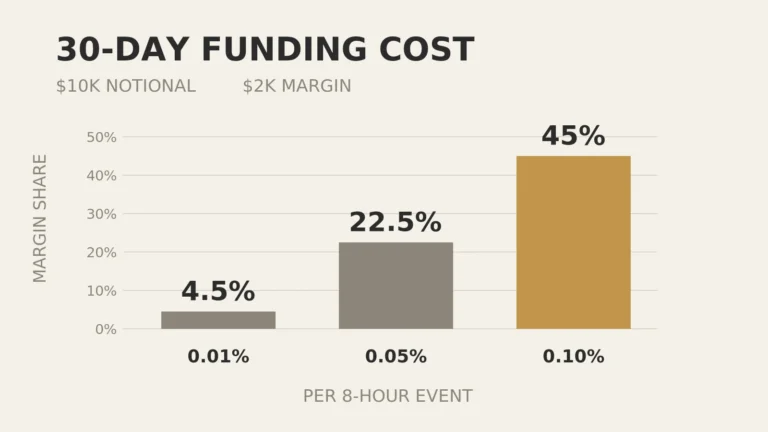
Funding is a transfer under the contract’s rules. In a common arrangement, longs pay shorts when the rate is positive. Shorts pay longs when the rate is negative. The formula and timing vary across products. Some venues use periodic settlement and others accrue funding continuously or calculate it hourly.
A position can pay or receive funding without a new entry or exit order. The payment is usually based on eligible position notional, not just the margin initially posted. Positive funding does not predict the next price move or guarantee that shorts will profit.
A basic spot asset balance has no perpetual contract funding obligation. A separate borrowing agreement in spot margin trading can have interest or financing charges. Read the detailed perpetual funding rates guide for worked cash-flow calculations.
One Price Move, Two Fair Comparisons
The first question holds market exposure equal. The second holds starting capital equal. Do not mix the two.
| Comparison | Spot long | Perpetual long |
|---|---|---|
| Same $1,000 exposure, price falls 5% | $50 loss on $1,000 purchase | $50 loss on $1,000 notional, or 25% of $200 initial margin |
| Same $1,000 starting capital, price falls 10% | $100 price loss | $500 theoretical loss on $5,000 notional at 5x |
Important: These are hypothetical price-related calculations before costs. A real perpetual position can be liquidated before the full theoretical loss occurs.
Can You Short Both Products?
Buying cryptocurrency through an ordinary spot trade creates a long asset balance. A fall in its market price reduces the value of the holding. Selling an existing holding is not the same as opening a new short position.
A perpetual contract typically lets you choose either long or short exposure. A short contract can gain when its price falls and lose when it rises. A short still needs collateral and can face funding charges or liquidation if losses weaken the account.
Some platforms support shorting through borrowed spot assets. That is spot margin trading, which uses a borrowing arrangement rather than a perpetual contract. If an exchange screen offers a Short button, check the product details instead of assuming every short works the same way.
The Academy lesson on open interest explains the quantity of outstanding derivatives contracts. It is useful context, but it does not replace identifying the product being traded.
What Costs and Other Risks Are Different?
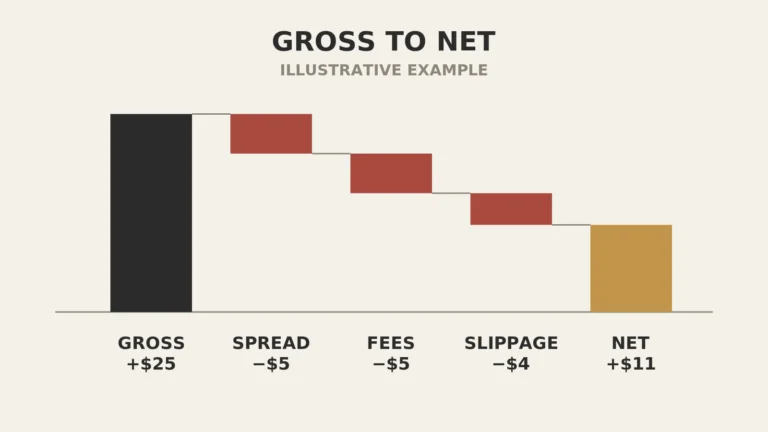
Both instruments can involve trading fees, bid-ask spread and slippage. The spread is the difference between the best quoted buying and selling prices. Slippage is the difference between a reference or expected fill and the actual execution price.
Spot holdings can face custody risks, withdrawal restrictions and network transaction fees when assets move on-chain. Perpetual positions add the contract’s margin rules, funding transfers, possible liquidation costs and settlement-currency exposure. Depending on the platform, collateral may also carry its own custody or issuer risk.
The trading costs article shows how to reconcile fills and fees without double counting spread or slippage. Funding and position-closeout costs need their own entries in the perpetual trade record.
Regulatory availability differs by region. A product offered under one exchange entity can have different terms from a product with a similar label elsewhere. Verify the actual contract specifications and customer eligibility. The U.S. Commodity Futures Trading Commission also warns that leverage amplifies losses in virtual-currency derivatives.
A Practical Product Check Before Placing an Order
Use the trading screen as evidence, not just as a familiar chart. Check these six details in the order ticket and contract specification.
- Instrument: Identify spot, perpetual, dated future or borrowed spot margin.
- Account result: Confirm whether execution creates a crypto balance or a contract position.
- Exposure: Record the full notional value and the money allocated as collateral.
- Risk boundary: Check maintenance margin, liquidation methodology and other eligible balances.
- Ongoing costs: Read funding, borrowing and settlement rules, plus trading fees.
- Exit: Confirm how the position is closed and what happens if an order only partly fills.
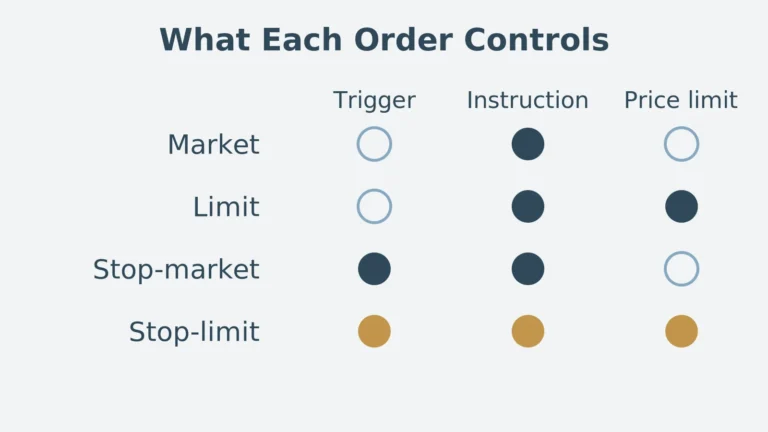
Do not rely on a displayed leverage number alone. Two platforms may define margin requirements or settlement differently. For execution details, see the market, limit and stop orders guide.
Frequently Asked Questions
Is a 1x perpetual future the same as spot?
No. A 1x perpetual can have roughly similar long price exposure to a fully funded spot purchase, but it remains a derivative. Contract settlement, funding, margin rules and ownership are different.
Can a perpetual be held indefinitely?
A standard perpetual has no fixed expiration date. That does not guarantee an uninterrupted position. Liquidation, platform controls, collateral changes or delisting rules can end it.
Can losses exceed the initial margin?
They can under some products and account rules. A forced closeout does not create a universal loss cap. Read the venue’s negative-balance and liquidation terms, especially when collateral or other positions are shared.
Understand the Product Before the Position
A spot purchase and a perpetual contract can track similar prices but place different assets and obligations in the account. The first creates a crypto balance. The second creates a margin-backed derivative position.
Start every comparison by keeping the same market exposure. Then examine how the required capital, funding, liquidation risk and custody terms change. That sequence gives a clearer decision than looking at leverage or the chart alone.
Key takeaways
- A spot purchase creates an asset balance, not automatic private-key control.
- A perpetual futures position creates contractual exposure without delivering the underlying asset.
- Equal notional exposure creates comparable price-related dollar changes before costs.
- Leverage changes the loss relative to collateral and can trigger liquidation.
- Funding and platform rules can affect a perpetual without a new trade.
Product: Identify an asset purchase or a derivative contract.
Balance: Verify what appears after execution.
Exposure: Separate notional value from posted collateral.
Obligations: Review funding, custody and maintenance rules.
Exit: Check closing, liquidation and withdrawal conditions.
Sources
- Kraken, What Is Crypto Margin Trading?. Spot trading, borrowed spot margin and derivatives distinctions.
- Coinbase International Exchange, What Is a Perpetual Future?. Contract exposure and absence of scheduled expiration.
- Coinbase International Exchange, Perpetual Futures Product Specifications. Linear contract and settlement-currency examples.
- Coinbase, Exchanges and Self-Custody Wallets. Exchange custody and control of private keys.
- Coinbase, Margin Management for Global Derivatives. Initial margin, maintenance margin and account equity.
- Binance, Introduction to Binance Futures Funding Rates. Contract-dependent funding payments.
- CFTC, Understand the Risks of Virtual Currency Trading. Volatility and leveraged futures risks.
The next step is understanding how order choices affect real execution. Nobilora Free Lessons provide the core market concepts for reviewing trades and risk.