Learn how position sizing connects account risk, stop distance, and trade invalidation so every trade fits a predefined risk budget.

Position Sizing: How to Size Trades by Risk
- Define invalidation before calculating size.
- Set the risk budget before entry.
- Measure monetary risk per unit.
- Let position size adapt to stop distance.
- Check costs and total exposure.
- Reject trades that exceed your limits.
Position sizing connects technical analysis with capital protection. It converts a valid trade idea into an exposure level that fits a predefined risk framework.
A strong setup can still become a poor trade when the position is too large. Position sizing solves that problem by connecting the amount of capital you are prepared to risk with the distance between your entry and the point where the trade thesis is invalid.
The sequence matters. Define invalidation first. Set the risk budget second. Calculate position size third. Only then consider leverage, margin and execution constraints.
This keeps two different decisions separate. Technical analysis determines where the trade is wrong. Risk management determines how much being wrong is allowed to cost.
What Position Sizing Actually Controls
Position sizing is the process of deciding how many units, shares, coins, or contracts to trade so that the planned loss at the stop fits a predefined risk budget.
It does not determine whether a setup is good. It determines how much financial weight that setup receives inside the account.
This distinction matters because conviction is not a position-sizing formula. A setup can look unusually strong and still fail. Increasing size simply because a trade feels convincing converts subjective confidence into additional financial exposure.
A consistent process works in the opposite direction. Define the trade first. Price the risk second. Let size become the output.
Position Sizing Starts With Invalidation
Before calculating position size, identify the price level where the original trade thesis no longer holds.
The stop should have a technical reason. Depending on the strategy, invalidation might sit beyond a structural high or low, outside a support or resistance area or beyond another level that proves the setup wrong.
A clear understanding of market structure helps distinguish meaningful invalidation from ordinary price movement.
The important principle is simple. Do not choose the position size first and then move the stop until the expected loss looks acceptable. That reverses the process and can place the stop inside normal market noise.
Your entry and exit structure defines the trade. Position sizing determines how much of that trade the account can carry.
The Position Size Formula
The basic relationship is:
Position size = maximum dollar risk / monetary risk per unit
Consider an illustrative account with $20,000 of equity. Assume the trader’s predefined plan permits $150 of risk on a particular trade.
Now assume an illustrative BTC entry at $70,000 with structural invalidation at $68,500. The distance from entry to stop is $1,500 per BTC.
The calculation is:
$150 / $1,500 = 0.10 BTC
Before trading costs and execution effects, 0.10 BTC is the position size that connects the $150 risk budget with the $1,500 risk per BTC.
The account value, risk amount, BTC prices, and resulting position are illustrative. They are not current market data or recommended risk parameters.
Why Stop Distance Changes Position Size
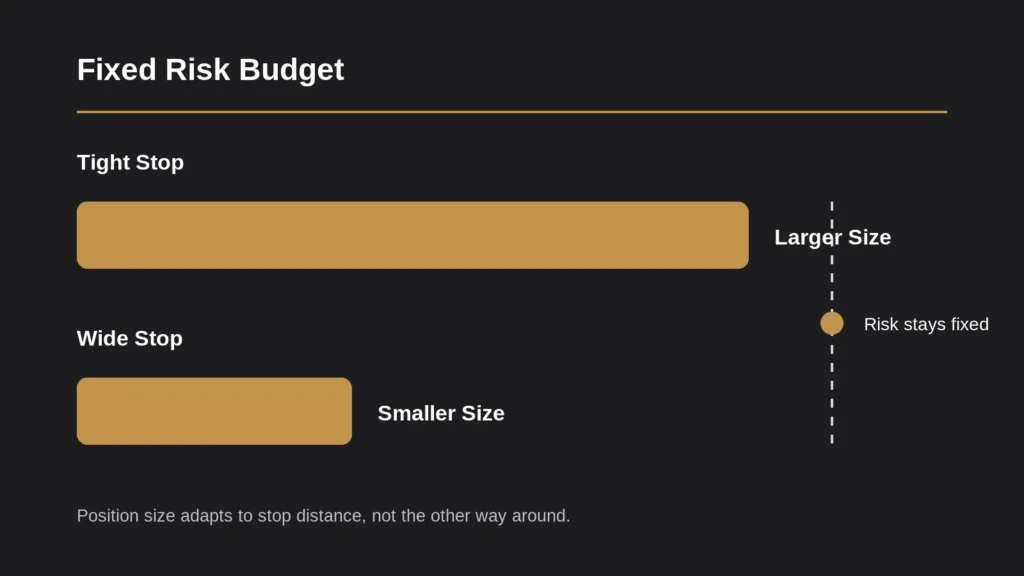
When the maximum dollar risk stays fixed, position size must move in the opposite direction from stop distance.
Using an illustrative $150 risk budget, $500 of risk per unit permits 0.30 units. A $1,000 distance permits 0.15 units. A $1,500 distance permits 0.10 units. A $3,000 distance permits 0.05 units.
The risk budget has not changed. The position has adapted to the structure of the trade.
This is why a wider stop does not automatically mean more account risk. If the wider stop is technically justified, reducing the position size can keep planned dollar risk unchanged.
Market conditions also matter. Changes in liquidity and volatility can affect how much structural room a trade requires and how reliably an exit can be executed.
Position size should adapt to trade structure. When valid invalidation moves farther from entry, position size must fall if the risk budget stays fixed. This keeps technical logic separate from capital exposure.
Why Fixed Position Size Creates Hidden Risk
Trading the same notional position on every setup does not produce the same risk.
Consider an illustrative $10,000 position. A stop 1% from entry represents roughly $100 of price risk before costs. A stop 4% away represents roughly $400.
The notional exposure is identical. The planned loss is not.
Fixed position size therefore creates variable account risk whenever stop distance changes. Risk-based sizing reverses the relationship. The risk budget is defined first and the position adapts.
Leverage and Position Size Are Different Decisions
Leverage and position sizing are related, but they answer different questions.
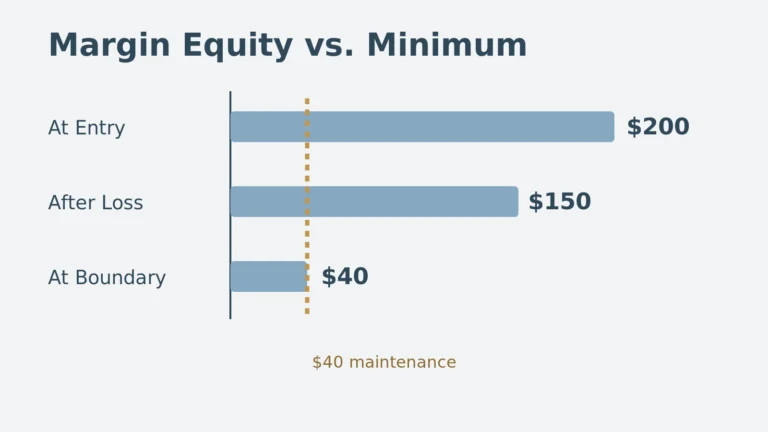
Position sizing determines the exposure that fits the risk budget and stop distance. Leverage affects how much margin is required to support that exposure and can materially affect the distance to liquidation in leveraged products.
This means leverage should not be used as a substitute for sizing. A platform may make a much larger position available than the trade’s risk budget can support.
Liquidation also makes leveraged trading more complex than the basic position-size formula suggests. Exchange liquidation calculations can depend on position notional, maintenance margin requirements, margin mode, wallet balance, mark price, and other variables. Binance, for example, documents different inputs for cross and isolated margin calculations and applies maintenance margin tiers based on position value.
For that reason, the correct workflow is not to estimate liquidation from leverage alone. Calculate the risk-based position first, then verify the exact margin and liquidation conditions for the instrument and venue before execution.
Trading Costs Belong in the Risk Check
The basic formula measures the price distance between entry and stop. Realized loss can be different.
Fees, spread, slippage, funding, gaps, contract specifications, and the behavior of the stop order can affect the final result. Their importance depends on the instrument and execution environment.
This becomes especially relevant when the planned stop is tight. A tighter stop allows a larger position for the same price-risk budget. Because many trading costs scale with position value, those costs can become a larger share of the intended loss.
The simple formula is therefore a starting point, not a guarantee that realized loss will equal the calculated amount.
Risk Per Trade Is a Framework Decision
There is no universal percentage that every trader should risk on every trade.
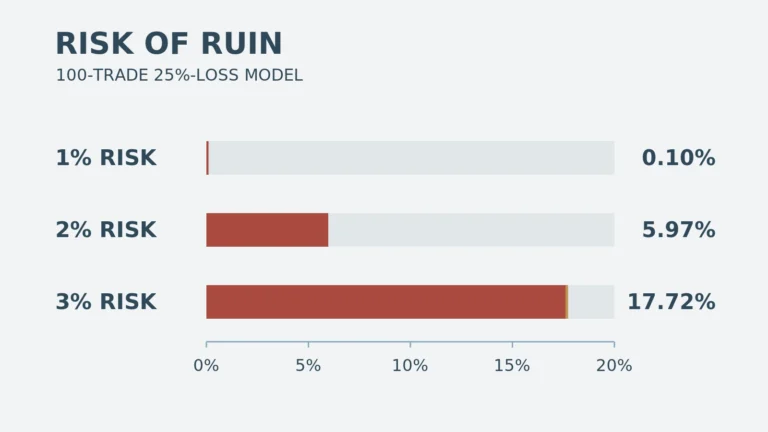
The appropriate risk framework depends on account objectives, strategy behavior, expected losing sequences, instrument characteristics, total exposure and the trader’s tolerance for drawdown.
What matters for position sizing is that the risk limit is defined before the current trade creates emotional pressure to change it.
A percentage-based model has one useful mechanical property. When risk is calculated from current account equity, the dollar amount exposed naturally declines after losses and increases after gains.
For example, ten consecutive losses at 1% of current equity do not produce a 10% drawdown. Compounding leaves the account approximately 9.6% below its starting value. At 2% per trade, the same ten-loss sequence produces a drawdown of approximately 18.3%.
These figures are mathematical illustrations, not recommended risk levels. Their purpose is to show why position size and drawdown are connected.
Structure First, Size Second
Wrong sequence: Choose the desired position size, decide how much loss looks acceptable, then move the stop until the numbers fit.
Correct sequence: Define structural invalidation, set the risk budget, calculate position size, then verify costs and execution constraints.
If the resulting position cannot be executed within your limits, reject the trade rather than weakening the invalidation logic.
Total Account Risk Can Be Larger Than Trade Risk
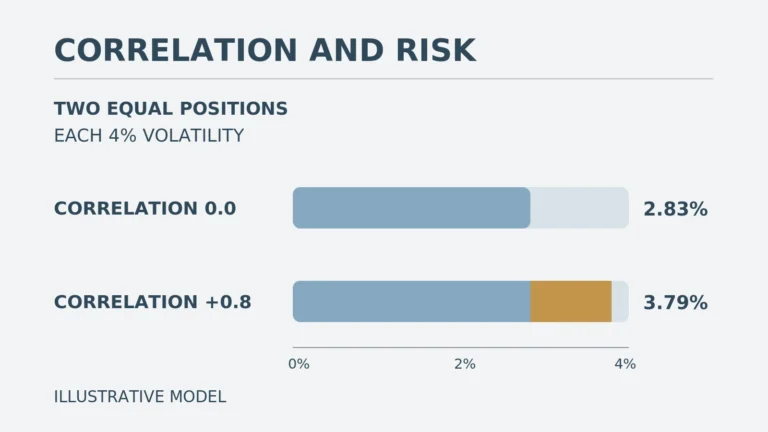
A position can fit its individual risk limit and still create excessive exposure when combined with other positions.
Two instruments may respond to the same underlying market driver. If both positions move against the account together, evaluating each trade in isolation can understate the practical concentration of risk.
Correlation is not fixed, so related positions should not automatically be treated as perfectly identical exposures. The useful question is whether the new trade materially increases exposure to a risk already present elsewhere in the account.
This makes total exposure a separate check after the individual position has been calculated.
When a Valid Setup Should Be Rejected
Position sizing can reveal that a technically valid setup does not fit the account or the instrument.
- The minimum tradable size exceeds the permitted risk.
- Execution costs materially increase the expected loss.
- The structural stop requires an impractical position.
- Existing positions already consume the available risk budget.
- Related positions create excessive concentration.
- Margin or liquidation conditions conflict with the planned stop.
In these situations, changing the invalidation level simply to preserve the trade changes the setup itself. The disciplined outcome may be to reject the trade.
Common Position Sizing Mistakes
Choosing Size From Confidence
Feeling more certain about a setup does not automatically justify greater financial exposure. If a trading plan intentionally uses different risk levels for different setup classes, those rules should exist before the trade appears.
Moving the Stop to Preserve a Larger Position
This reverses the correct sequence. Structural invalidation should determine the stop. The position then adapts to that distance.
Letting Leverage Decide Position Size
Available leverage describes what the platform may permit. It does not define the loss the account should accept.
Ignoring Execution Costs
A position calculated to the exact theoretical risk limit can exceed that limit after fees, spread, or slippage.
Treating Every Position as Independent
Several individually acceptable trades can combine into concentrated account exposure. Review the new position in the context of positions already open.
Increasing Risk to Recover a Loss
Changing size because of the previous trade replaces the predefined process with an emotional response. Any drawdown rule should be established before the drawdown occurs.
A Practical Position Sizing Workflow
- Define the thesis. State what must remain true for the trade idea to stay valid.
- Locate invalidation. Mark the price where the thesis fails.
- Set the risk budget. Determine the maximum planned loss allowed by the trading framework.
- Measure unit risk. Convert the distance from entry to stop into monetary risk per unit.
- Calculate position size. Divide the risk budget by monetary risk per unit.
- Check execution costs. Consider fees, spread, slippage, funding, and instrument mechanics where relevant.
- Check total exposure. Review existing positions and related market risk.
- Check leverage and liquidation. For leveraged products, verify the venue’s actual margin and liquidation conditions.
- Accept or reject. Execute only when the complete position fits the trading plan.
This sequence keeps the logic clean. The market structure determines invalidation. The trading plan determines acceptable risk. Position size connects the two.
Position Sizing and Trade Review
Position sizing also creates a common unit for reviewing trades.
One approach is to express outcomes as multiples of the initial risk, commonly called R-multiples. If the planned initial risk is defined as 1R, a loss equal to that amount is minus 1R, while a profit equal to twice the initial risk is plus 2R. Van Tharp’s educational material uses this framework to separate trade outcomes from raw account size.
This can make a trading journal more useful because trades with different position sizes can be compared through the amount initially placed at risk.
Position Size Connects Analysis With Capital
A trade idea answers whether a setup is worth considering. Position sizing answers how much capital can be exposed if that idea is wrong.
Keep those decisions separate. Define the thesis and invalidation first. Apply the account risk framework second. Calculate position size third. Then check costs, total exposure, and leveraged-product constraints.
When the resulting position does not fit the instrument, execution conditions, or account limits, the correct position may be no position at all.
The broader risk management framework connects this process with capital protection, drawdown control and trading discipline.
Key takeaways
- Position size is an output of trade structure and risk limits.
- A wider valid stop requires a smaller position when risk stays fixed.
- Leverage changes margin requirements but does not replace position sizing.
- Execution costs can make realized loss exceed the simple stop calculation.
- Several related positions can create more account risk than each shows alone.
Invalidation: Mark where the trade thesis fails.
Risk budget: Define the maximum planned loss.
Unit risk: Measure monetary risk from entry to stop.
Position size: Divide risk budget by unit risk.
Cost check: Account for relevant execution costs.
Exposure check: Review related open positions.
Execution check: Verify margin and liquidation where applicable.
Sources
Position sizing works best inside a complete process that connects structure, entries, exits, risk and review. Continue into the Nobilora Academy to build those decisions into one repeatable framework.